
Punjab's AI Education Mandate: What It Means for India's Future Workforce
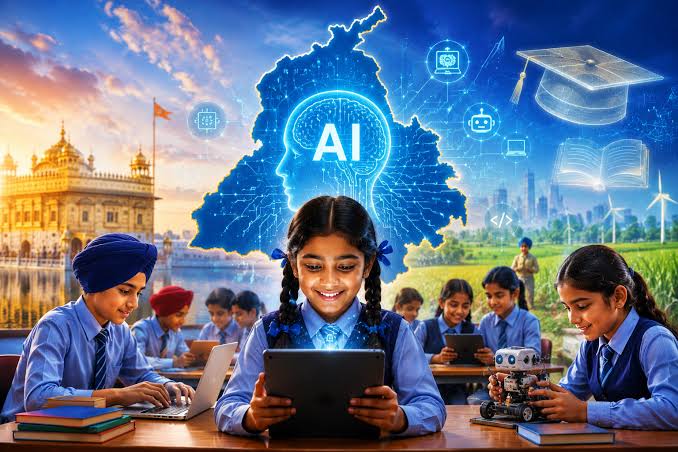
Punjab has become the first Indian state to make Artificial Intelligence education mandatory from Class 1 to 12, setting a precedent for national educational reform. This bold move aims to equip students with critical skills, preparing them for an increasingly AI-driven global economy and workforce.
Reading this article: 0s
News in 60 words
~150-word AI digest in one read
Thesis, bullets, quote & takeaway — slogan stays "60 words"
7d ·6 min read· 0 · 0 · 0
Full story
Punjab Leads the Way: A New Era for Indian Education
In a landmark decision that could reshape India's educational landscape, Punjab has emerged as the first state to mandate Artificial Intelligence (AI) education for students from Class 1 to Class 12. This forward-thinking initiative is not just an academic upgrade; it's a strategic investment in the future, aiming to equip the next generation with the foundational knowledge and critical thinking skills needed to thrive in an AI-powered world. As India races to become a global technology leader, Punjab's move signals a proactive approach to preparing its youth for jobs that are rapidly evolving or don't even exist yet.
The global economy is increasingly driven by AI, and nations worldwide are scrambling to build a robust talent pipeline. For India, with its vast young population, integrating AI education early is paramount. Punjab's mandate aligns perfectly with the National Education Policy (NEP 2020)'s emphasis on 21st-century skills, critical thinking, and experiential learning. This pioneering step by a state often known for its agricultural prowess demonstrates a clear vision for diversifying its human capital and contributing significantly to India's digital future.
The Scope and Vision Behind Punjab's Mandate
Making AI education mandatory across all school grades, from primary to senior secondary, is an ambitious undertaking. For younger students (Class 1-5), the curriculum is expected to focus on foundational concepts like pattern recognition, logical thinking, and problem-solving through play-based activities, without delving into complex coding. Imagine children in Ludhiana learning to identify patterns in nature or classify objects, building the cognitive groundwork for AI.
As students progress (Class 6-8), they might be introduced to basic computational thinking, algorithms, and the ethical implications of technology through interactive tools. For senior students (Class 9-12), the curriculum will likely involve more hands-on coding, machine learning concepts, data analysis, and an understanding of AI applications in various industries, from healthcare to agriculture. This age-appropriate scaffolding ensures a comprehensive and digestible learning journey for every child in Punjab.
Navigating the Implementation Challenges
While the vision is clear, the practical implementation of such a widespread mandate presents several challenges. The most significant hurdles include teacher training, infrastructure development, and curriculum design. For instance, how will thousands of teachers across diverse government and private schools in cities like Amritsar, Jalandhar, and rural areas be upskilled to teach AI concepts effectively?
- Teacher Training: A massive, ongoing training program for educators is essential. This could involve collaborations with technical universities, online learning platforms, and government bodies like SCERTs (State Council of Educational Research and Training) to develop specialized modules. The focus must be on practical understanding, not just theoretical knowledge.
- Infrastructure: Many schools, especially in remote areas, lack adequate computer labs, stable internet connectivity, and even reliable electricity. Investing in digital infrastructure, providing devices, and ensuring maintenance will be crucial. Public-private partnerships could play a vital role here.
- Curriculum Development: Crafting a dynamic, engaging, and age-appropriate curriculum that balances theoretical knowledge with practical skills is key. It needs to be regularly updated to keep pace with rapid advancements in AI technology, drawing insights from industry experts and educational psychologists.
Impact on India's Future Workforce and Global Competitiveness
Punjab's AI education mandate is a powerful catalyst for preparing India's future workforce. By introducing AI concepts early, students will develop computational thinking, problem-solving abilities, and an innovative mindset from a young age. This early exposure can demystify AI, making it accessible and fostering a generation comfortable with leveraging technology for creative solutions.
This initiative will significantly boost India's talent pool, nurturing future data scientists, AI engineers, machine learning specialists, and AI ethicists. It will also equip individuals in non-tech fields with AI literacy, enabling them to adapt to AI-driven changes in their respective industries. For example, a student from Bathinda learning AI might later apply it to optimize crop yields or manage supply chains, directly benefiting local industries. Such a skilled workforce will undoubtedly enhance India's global competitiveness in the AI domain, attracting investments and driving innovation across sectors.
A Blueprint for Other Indian States
Punjab's pioneering effort sets a compelling precedent for other Indian states to follow. The success of this model could inspire states like Karnataka, known for its tech hub Bengaluru, or Maharashtra with its strong industrial base, to adopt similar policies. While the specific implementation might vary based on local contexts and resources, the core principle of universal AI education can be replicated.
Adopting a national framework for AI education, possibly spearheaded by the Ministry of Education, could further accelerate this transformation. This would ensure standardization, resource sharing, and a coordinated effort to build an AI-ready nation. Ultimately, an AI-literate population across India can drive economic growth, foster innovation, and address complex societal challenges, from healthcare accessibility to environmental sustainability, leveraging the power of intelligent technologies.
Frequently Asked Questions
What specific topics will be covered for young children (Class 1-5)?
For young children, the curriculum will focus on foundational concepts rather than complex coding. This includes activities that develop pattern recognition, logical reasoning, sequential thinking, and basic problem-solving skills. Examples might involve simple game-based learning, identifying categories, understanding cause-and-effect, and learning about how everyday smart devices (like voice assistants or recommendation systems) work at a conceptual level.
How will teachers be trained for this new AI curriculum?
Teacher training is a critical component. Punjab plans to implement comprehensive training programs for educators, likely in phases. These programs will involve workshops, online modules, and certification courses, focusing on both the theoretical understanding of AI and pedagogical approaches to teach it effectively to different age groups. Collaborations with academic institutions, industry experts, and ed-tech platforms are expected to provide the necessary resources and expertise for upskilling the teaching fraternity.
Will mandatory AI education make schooling more expensive for students?
The aim of government initiatives like this is typically to make education accessible. While there will be investments in infrastructure and teacher training, the state government will likely bear the primary costs for public schools. For private schools, the implementation costs might be factored into fees, but the overall goal is to integrate AI education as a standard part of the curriculum, much like other subjects, rather than as an expensive add-on. Government schemes and grants may also be introduced to support schools in this transition.
Conclusion: Building an AI-Powered India
Punjab's decision to embed AI education from Class 1 to 12 is a monumental step towards future-proofing its youth and contributing significantly to India's ambition of becoming a global AI powerhouse. It's an acknowledgment that digital literacy in the 21st century extends beyond just using computers to understanding the intelligence behind them. While challenges in implementation will arise, the long-term benefits of fostering a generation proficient in AI thinking far outweigh them.
This mandate is more than just a curriculum change; it's a cultural shift, encouraging innovation, critical inquiry, and ethical technological engagement from a young age. As Punjab embarks on this transformative journey, it provides a valuable blueprint for other states, urging them to consider similar initiatives to collectively build an AI-powered India ready to lead the technological revolution.
Support creators
Was this helpful?
Your feedback helps us improve content for everyone.
Liked this piece?
Tip Dhananjay for the work
100% goes to the creator. Send a one-time tip in rupees and back the writing you love.
Dhananjay Chauhan
0 followers · 0 blogs
Creator on ContentVerse. Building, writing, and shipping in public.
0 followers
Discussion