
Dowry demand need not be proved by documents: High court restores husband’s conviction
NEW DELHI: The Madhya Pradesh high court has held that a prior agreement is not necessary to establish the offence, restoring a husband's conviction for dowry h
(1h)4 min read 0 0 0
Creator on ContentVerse. Building, writing, and shipping in public.
Reading this article: 0s
News in 60 words
~150-word AI digest in one read
Thesis, bullets, quote & takeaway — slogan stays "60 words"

Full story
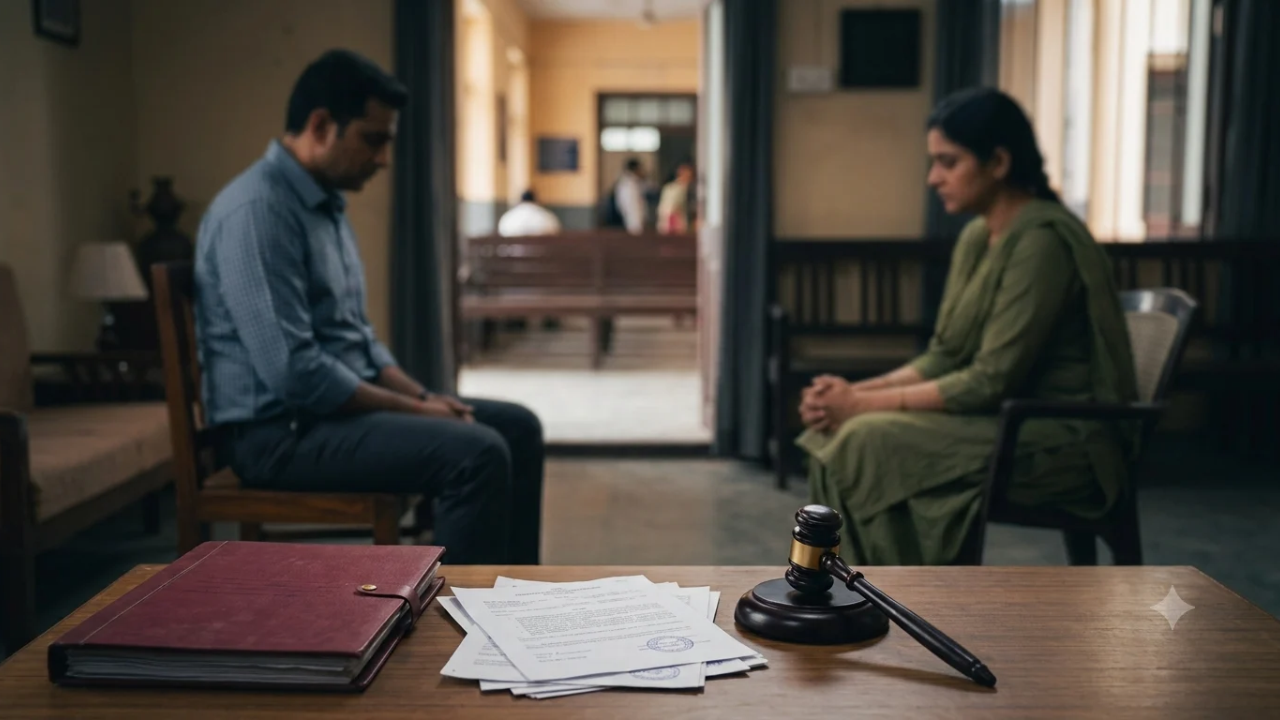
NEW DELHI: The Madhya Pradesh high court has held that a prior agreement is not necessary to establish the offence, restoring a husband's conviction for dowry harassment. The court also directed that jewellery seized during the investigation be returned to the woman, ruling that it remained her exclusive property.
In its October 13, 2026, order, the high court set aside the acquittal of the husband under Section 498A of the Indian Penal Code (IPC) and Section 4 of the Dowry Prohibition Act. The court restored his sentence of one year's rigorous imprisonment and a fine of Rs 1,000 under each provision.
Why did the woman approach the high court?According to the court order, the woman lodged an FIR on August 6, 2007, alleging that her husband and father-in-law had harassed her over dowry. She alleged that her parents had given Rs 17 lakh, jewellery and household articles at the time of marriage, but her in-laws expected Rs 25 lakh and demanded the remaining Rs 8 lakh.
She alleged that she was physically and mentally harassed when the demand was not met and was eventually forced to leave her matrimonial home. During the investigation, police recovered her jewellery from a bank locker in Mumbai.
The trial court convicted her husband and father-in-law on April 3, 2017, under Section 498A of the IPC and Section 4 of the Dowry Prohibition Act, sentencing each to one year's rigorous imprisonment and a fine of Rs 1,000 under each provision. It acquitted them of charges of criminal intimidation and criminal breach of trust.
The sessions court set aside the convictions on March 2, 2019, acquitting them of the dowry-related offences. The woman then appealed to the high court, arguing that the sessions court had wrongly treated the absence of a fixed agreement before marriage as a reason to reject evidence of subsequent dowry demands.
The accused opposed her appeal, citing inconsistencies in the evidence, including the description of the Rs 17 lakh allegedly given at marriage and the lack of a prior agreement. Why did the high court restore the conviction?Justice Alok Awasthi found that the woman's testimony was supported in material particulars by statements from her mother, brother, father and her father's friend.
The evidence described repeated demands for Rs 8 lakh, including incidents at her parental home in Indore. The court held that the absence of a prior agreement specifying the amount of dowry could not defeat the prosecution.
It said demands made after marriage could also attract the law when connected with the marriage."The demand of money as dowry can be proved only by producing the documentary evidence," the court noted. The court's point was that the law does not require documentary proof of a dowry demand; oral testimony can establish it.
It also rejected the sessions court's reliance on differences in witnesses' accounts, noting that the events occurred in 2007 while statements were recorded years later."The whole crux of above incidents or gone minutely to the statements, well establishes that the respondent Nos. 2 & 3 had demanded dowry and on failure to receive it, subjected the appellant to physical and mental harassment," the court said. It found that the sessions court had focused on discrepancies about the amount given at marriage, the absence of financial documents and differences in witness narration, without adequately addressing evidence of repeated demands.
The court also explained that Section 498A covers harassment intended to coerce a woman or her relatives into meeting an unlawful demand for property. This is a separate form of cruelty from conduct likely to drive a woman to suicide or cause grave injury; the prosecution did not have to establish both.
The high court also examined the seized jewellery, which had been recovered from a joint bank locker. The record included a list of gifts and ornaments, a seizure memo, jewellery invoices, a valuation certificate and the husband's statement identifying the articles as belonging to his wife.
Relying on the Supreme Court's ruling in Smt. Rashmi Kumar v Mahesh Kumar Bhada (1997), the court said:"The ornaments and gifts received by her before or at the time of marriage or thereafter, remain her exclusive property, over which the husband has no ownership or independent right.
Merely because such ornaments are kept in the custody of the husband or in a joint bank locker, their ownership does not become joint," the court added. The high court restored the direction to hand over the seized jewellery to the woman after finding sufficient material supporting her ownership.
The appeal against the father-in-law abated following his death in March 2024. The husband's acquittals under IPC Sections 506 Part II and 406 were left undisturbed.
He was directed to surrender before the trial court within seven days to serve the remaining sentence.
Key quotes
-
“The demand of money as dowry can be proved only by producing the documentary evidence,”
-
“The whole crux of above incidents or gone minutely to the statements, well establishes that the respondent Nos. 2 & 3 had demanded dowry and on failure to receive it, subjected the appellant to physical and mental harassment,”
Was this helpful?
Your feedback helps us improve content for everyone.
Liked this piece?
Tip Dhananjay for the work
100% goes to the creator. Send a one-time tip in rupees and back the writing you love.
Dhananjay Singh
3 followers · 552 blogs
Published 22 Oct 2026, 1:00 pm IST
Creator on ContentVerse. Building, writing, and shipping in public.
Reviewed by the ContentVerse India editorial team. Educational pages are not personalised advice.
View full profile3 followers
Discussion