
Monsoon Home Workouts: 30-Day Strength & Cardio Plan for Indian Fitness
As the monsoon rains sweep across India, staying active can be a challenge, making structured home fitness more crucial than ever. This 30-day plan combines strength and cardio, designed to keep you fit and energized without stepping out.
Reading this article: 0s
News in 60 words
~150-word AI digest in one read
Thesis, bullets, quote & takeaway — slogan stays "60 words"
2d ·7 min read· 0 · 0 · 0
Full story
As the monsoon clouds gather and heavy rains lash across cities from Mumbai to Kolkata, outdoor activities often come to a grinding halt. For many in India, this means a disruption to regular fitness routines, leading to reduced activity levels and a potential dip in mood and health. But staying fit doesn't require sunshine or a gym membership; your home can be your ultimate fitness sanctuary.
This 30-day strength and cardio plan is specifically designed for Indian homes, keeping in mind space constraints, accessibility to equipment, and the desire to maintain peak physical and mental health during the wettest months. It’s about making fitness an integral part of your monsoon routine, ensuring you emerge stronger and healthier when the skies clear.
The Monsoon Fitness Imperative
The monsoon season, while beautiful, brings its own set of challenges. Waterlogged streets, increased humidity, and the risk of seasonal illnesses like dengue and malaria can deter even the most dedicated fitness enthusiasts from stepping out. Gyms might be inconvenient to reach, or you might prefer the comfort and safety of your own space.
Indoor workouts offer a fantastic solution. They allow you to control your environment, avoid slippery roads, and maintain consistency regardless of the weather outside. A structured home plan ensures you don't just 'stay active' but actively work towards specific fitness goals, building strength and improving cardiovascular health.
Building Your Home Gym (Indian Style)
You don't need expensive equipment to kickstart your fitness journey. Many common household items can serve as effective workout tools, making home fitness accessible and affordable for everyone across India.
Here’s what you might need, and how to improvise:
- Yoga Mat: Essential for comfort and grip during floor exercises. Easily available for around ₹500-₹1500 online or at local sports shops.
- Water Bottles/Bricks: For light weights. A pair of 1-litre water bottles filled with water or sand, or even a couple of bricks, can substitute for dumbbells for exercises like bicep curls or shoulder presses.
- Sturdy Chair/Stool: For elevated exercises like triceps dips, box squats, or step-ups. Ensure it’s stable and can bear your weight.
- Resistance Bands: A set of resistance bands (light, medium, heavy) can add intensity to bodyweight exercises and are compact. A basic set costs around ₹300-₹800.
- Skipping Rope: An excellent cardio tool that requires minimal space. Available for ₹150-₹400.
Remember, consistency and proper form are far more important than fancy equipment. Start with what you have and gradually add items if needed.
The 30-Day Strength & Cardio Blueprint
This plan focuses on a balanced approach, incorporating three days of strength training and two days of cardio, with two rest days to allow for recovery. Each workout should include a 5-minute warm-up (light jogging in place, arm circles, leg swings) and a 5-minute cool-down (static stretches).
Weekly Schedule:
- Monday: Full Body Strength
- Tuesday: Cardio Focus
- Wednesday: Full Body Strength
- Thursday: Rest or Active Recovery (light walk, stretching)
- Friday: Full Body Strength
- Saturday: Cardio Focus
- Sunday: Rest
Strength Training (Perform 3 sets of 10-15 repetitions for each exercise):
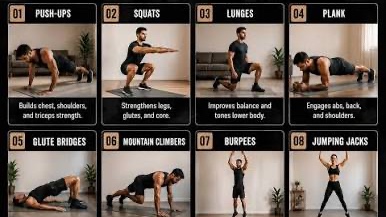
- Squats: Bodyweight or holding water bottles. Focus on keeping your back straight and knees behind your toes.
- Lunges: Alternating legs. Step forward, lower hips until both knees are bent at a 90-degree angle.
- Push-ups: On knees or toes. If too difficult, do incline push-ups against a wall or sturdy table.
- Plank: Hold for 30-60 seconds. Engage your core, keep your body in a straight line.
- Glute Bridges: Lie on your back, knees bent, feet flat. Lift hips off the floor, squeezing glutes.
- Crunches/Leg Raises: For core strength. Focus on controlled movements.
- Triceps Dips: Using a sturdy chair. Lower your body until elbows are at a 90-degree angle.
- Resistance Band Rows: Anchor a band to a sturdy object or under your feet, pull towards your chest.
Cardio Focus (Perform each exercise for 45 seconds, rest 15 seconds, repeat circuit 3-4 times):
- High Knees: March or run in place, bringing knees up towards your chest.
- Butt Kicks: Run in place, trying to kick your glutes with your heels.
- Jumping Jacks (Modified): Step out one leg at a time instead of jumping if you need a low-impact option.
- Mountain Climbers: In a plank position, bring knees towards your chest alternately.
- Burpees (Modified): Step back into a plank, then step forward and stand up, omitting the jump if preferred.
- Skipping (if you have a rope and space): An excellent high-intensity cardio option.
Progression: As you get stronger, increase repetitions, add more sets, reduce rest time, or incorporate your resistance bands and improvised weights to make exercises more challenging.
Nutrition & Hydration During Monsoon
Exercising indoors means you might not feel as thirsty as you would outdoors, but staying hydrated is crucial. Drink plenty of water throughout the day. Aim for 2.5-3 litres, and consider adding lemon or mint for flavour and electrolytes.
Your diet plays a vital role in supporting your fitness goals. Focus on whole, unprocessed foods. Incorporate immunity-boosting ingredients common in Indian kitchens:
- Turmeric & Ginger: Add to curries, teas, or warm milk.
- Seasonal Fruits: Guava, pomegranates, apples, and bananas are excellent sources of vitamins and energy.
- Lean Proteins: Dal, paneer, eggs, chicken, and fish support muscle repair and growth.
- Complex Carbohydrates: Roti, brown rice, oats, and sweet potatoes provide sustained energy for your workouts.
Avoid excessive fried foods and street food during monsoon to prevent digestive issues and maintain a healthy gut, which is crucial for overall immunity.
Staying Motivated & Consistent
Monsoon days can sometimes feel sluggish, making motivation a challenge. Here are some tips to stay on track:
- Set a Schedule: Treat your workout time like an important appointment. Consistency is key.
- Track Your Progress: Use a notebook or a fitness app to log your workouts, reps, and sets. Seeing your improvement is a huge motivator.
- Workout Buddy (Virtual): Connect with a friend or family member for virtual workout sessions. Accountability can make a big difference.
- Vary Your Routine: While this plan provides a structure, feel free to swap exercises or try different cardio routines (e.g., dancing to your favourite Bollywood tunes!) to keep things interesting.
- Reward Yourself: Small, healthy rewards for reaching milestones can keep your spirits high.
Conclusion
The monsoon season doesn't have to put a damper on your fitness journey. With this 30-day strength and cardio plan, you have a structured, effective, and accessible way to stay fit, strong, and energized from the comfort of your home. Embrace the challenge, enjoy the process, and emerge from the rains feeling healthier and more resilient than ever.
FAQs
Q1: Can beginners follow this 30-day plan? A1: Absolutely! This plan is designed with modifications in mind. Beginners should start with fewer repetitions (e.g., 8-10 reps) or shorter cardio intervals (e.g., 30 seconds on, 30 seconds off) and gradually increase as their strength and stamina improve. Focus on mastering proper form before increasing intensity.
Q2: What if I have very limited space in my home, like in a small apartment in Delhi or Mumbai? A2: Many of these exercises require minimal space. Bodyweight movements like squats, lunges, planks, and crunches can be done in an area no larger than a yoga mat. For cardio, marching in place, high knees, and modified jumping jacks are excellent options that don't need much room. Consider moving furniture temporarily if needed.
Q3: How can I prevent injuries while working out at home without a trainer? A3: Injury prevention is paramount. Always perform a proper warm-up before and a cool-down after your workout. Focus on correct form over speed or intensity – watch videos if unsure. Listen to your body; if an exercise causes sharp pain, stop immediately. Don't push through discomfort, and ensure your workout area is clear of obstructions.
Support creators
Enjoyed this article? Consider tipping the writer on ContentVerse to support quality content creation.
Was this helpful?
Your feedback helps us improve content for everyone.
Liked this piece?
Tip Dhananjay for the work
100% goes to the creator. Send a one-time tip in rupees and back the writing you love.
Dhananjay Chauhan
0 followers · 0 blogs
Creator on ContentVerse. Building, writing, and shipping in public.
0 followers


Discussion