
How NRIs Can Invest in Indian Stocks and MFs via NRE Account: Step-by-Step Guide
Investing in India's surging equity markets as a Non-Resident Indian (NRI) is seamless when done through a Non-Resident External (NRE) account. This comprehensive guide covers regulatory compliance, PIS requirements, taxation, and step-by-step procedures to build your Indian portfolio.
Reading this article: 0s
News in 60 words
~150-word AI digest in one read
Thesis, bullets, quote & takeaway — slogan stays "60 words"
1h ·6 min read· 0 · 0 · 0
Full story
India's booming capital markets have captured global attention, prompting Non-Resident Indians (NRIs) across Dubai, London, Singapore, and New York to build wealth back home. With the Nifty 50 and Sensex demonstrating resilience, investing in Indian equities and mutual funds offers a compelling growth opportunity. However, navigating the regulatory ecosystem under the Foreign Exchange Management Act (FEMA) can feel overwhelming without a clear roadmap.
The Non-Resident External (NRE) account serves as the cornerstone for NRIs seeking fully repatriable investments in India. This guide walks you through the regulatory guidelines, step-by-step account opening process, tax implications, and key operational rules needed to invest smoothly.
This is educational content, not financial advice.
Why Choose an NRE Account for Equity Investments?
Before diving into setup procedures, it is essential to understand why the NRE account is the preferred medium for Indian capital market investments.
- Full Repatriability: Both the principal amount invested and the capital gains earned can be transferred back to your overseas bank account without any monetary limits or regulatory restrictions.
- Tax-Exempt Bank Interest: The interest earned on balance held in your NRE savings or fixed deposit account is completely tax-free in India under Section 10(15) of the Income Tax Act.
- Currency Flexibility: Funds deposited in foreign currencies (USD, AED, GBP, EUR) are automatically converted into Indian Rupees (INR) at prevalent exchange rates upon landing in your NRE account.
Unlike Non-Resident Ordinary (NRO) accounts, which handle income generated within India (such as rental income or pension) and carry repatriation limits of $1 million per financial year, NRE accounts are designed purely for foreign earned funds.
Regulatory Framework: RBI, FEMA, and the PIS Mechanism
To invest in Indian direct stocks, the Reserve Bank of India (RBI) mandates a specific framework known as the Portfolio Investment Scheme (PIS).
What is a PIS Account?
A Portfolio Investment Scheme (PIS) permission is a designated bank account linked to your NRE account. It tracks your secondary market equity transactions to ensure foreign holding limits in Indian companies are not breached.
Key details of PIS include:
- Mandatory for Direct Stocks: You must route all secondary stock market purchases and sales through a designated PIS bank account (offered by banks like HDFC Bank, ICICI Bank, or Axis Bank).
- Single PIS Account Limit: An NRI can hold only one designated PIS account for NRE transactions across all banks in India.
- Reporting Mechanism: The designated bank automatically reports all stock buy and sell transactions to the RBI on a daily basis.
Non-PIS Route for Mutual Funds
Unlike direct equities, buying units of Indian Mutual Funds does not require a PIS designation. NRIs can directly invest in equity or debt mutual funds through a simple non-PIS NRE account using investment platforms or AMC portals.
Step-by-Step Guide to Setup Your Investment Infrastructure
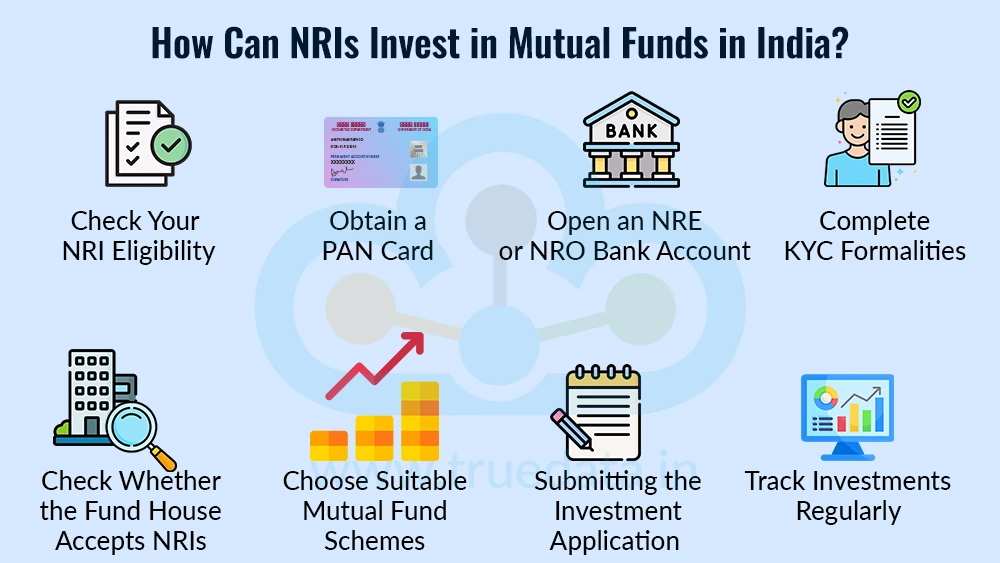
Setting up your investment accounts from abroad requires four major steps:
Step 1: Open an NRE Savings Account
Apply for an NRE account with an authorized dealer bank in India. Most top-tier Indian banks allow online paperless onboarding for NRIs residing in major global hubs.
Step 2: Apply for PIS Permission
If you plan to trade direct stocks, request your bank to issue a PIS permission letter. The bank will link a specialized PIS ledger to your main NRE savings account. A nominal one-time processing fee ranging from ₹500 to ₹2,000 applies.
Step 3: Complete In-Person Verification (IPV) and KYC
Complete the Know Your Customer (KYC) process compliant with CKYC standards. You will need to submit:
- Copy of valid Indian Passport (or OCI card for foreign citizens)
- Valid work visa, resident permit, or employment contract
- Proof of overseas address (utility bill, bank statement)
- Overseas tax identification number (e.g., SSN for US residents, TIN)
- FATCA / CRS declaration form
In-Person Verification (IPV) can be conducted online via a quick video KYC call with the discount broker or bank representative.
Step 4: Open NRI Demat and Trading Accounts
Link your NRE account and PIS letter with a SEBI-registered broker (such as Zerodha, ICICI Direct, or HDFC Securities). Ensure you select the "NRI - Repatriable (NRE)" account type during registration.
Taxation Rules and TDS for NRI Investors
Taxation for NRIs differs significantly from resident Indians, primarily because tax is deducted at source (TDS) on capital gains before the funds hit your account.
Equity Taxation (Post-Budget 2024 Updates)
- Short-Term Capital Gains (STCG): Stocks or equity mutual funds sold within 12 months are taxed at 20% (plus applicable surcharge and health/education cess).
- Long-Term Capital Gains (LTCG): Investments held for over 12 months are taxed at 12.5% on gains exceeding ₹1.25 lakh in a financial year.
- Dividend Tax: Dividend income from stocks and mutual funds is added to your income and taxed according to your applicable slab rate, with TDS deducted at 20%.
Because brokers or custodian banks deduct TDS at the time of sale or payout, NRIs often do not face additional tax liabilities in India unless they wish to claim tax refunds by filing an Indian Income Tax Return (ITR-2). Furthermore, you can utilize the Double Taxation Avoidance Agreement (DTAA) to claim tax credits in your country of residence.
Key Operational Constraints to Keep in Mind
- No Intraday or Short-Selling: NRIs are strictly prohibited from day trading or short-selling in Indian stocks using an NRE account. All equity transactions must be delivery-based.
- F&O Trading Requires NRO Route: If you wish to trade Futures & Options (F&O), you cannot use an NRE account. F&O trading requires an NRO account along with a Custodial Participant (CP) code.
- US and Canada FATCA Restrictions: Due to strict SEC regulations under FATCA, several Indian Asset Management Companies (AMCs) do not accept mutual fund investments from NRIs based in the United States and Canada. Check with specific AMCs like SBI Mutual Fund, ICICI Prudential, or Nippon India before investing.
Frequently Asked Questions
1. Can I use my existing resident savings account after moving abroad?
No. Under FEMA regulations, holding a resident savings account after acquiring NRI status is illegal. You must convert your existing resident account into an NRO account or close it upon changing your residential status.
2. Is PIS mandatory for investing in Indian Mutual Funds?
No, PIS is not required for mutual fund investments. NRIs can invest in Indian mutual funds directly through a regular NRE savings account via any mutual fund platform or AMC app.
3. How do I transfer sale proceeds back to my overseas bank account?
Since investments made via an NRE account are fully repatriable, the sale proceeds automatically credit back to your NRE account after TDS deduction. You can then wire these funds directly to your foreign bank account through net banking without submitting additional tax forms like 15CA/15CB.
Conclusion
Investing in Indian equities via an NRE account provides non-resident Indians with an efficient, fully repatriable pathway to participate in India's macroeconomic growth story. By setting up a compliant PIS account, completing NRI-KYC, and understanding TDS mechanics, you can systematically allocate capital across high-conviction stocks and mutual funds from anywhere in the world.
Support creators
If you found this guide helpful, consider supporting our financial research team with a small tip on ContentVerse India.
Was this helpful?
Your feedback helps us improve content for everyone.
Liked this piece?
Tip Dhananjay for the work
100% goes to the creator. Send a one-time tip in rupees and back the writing you love.
Dhananjay Singh
0 followers · 0 blogs
Creator on ContentVerse. Building, writing, and shipping in public.
0 followers



Discussion