
Inside India's AI Data Centre Boom: Growth, Power Needs & Green Concerns
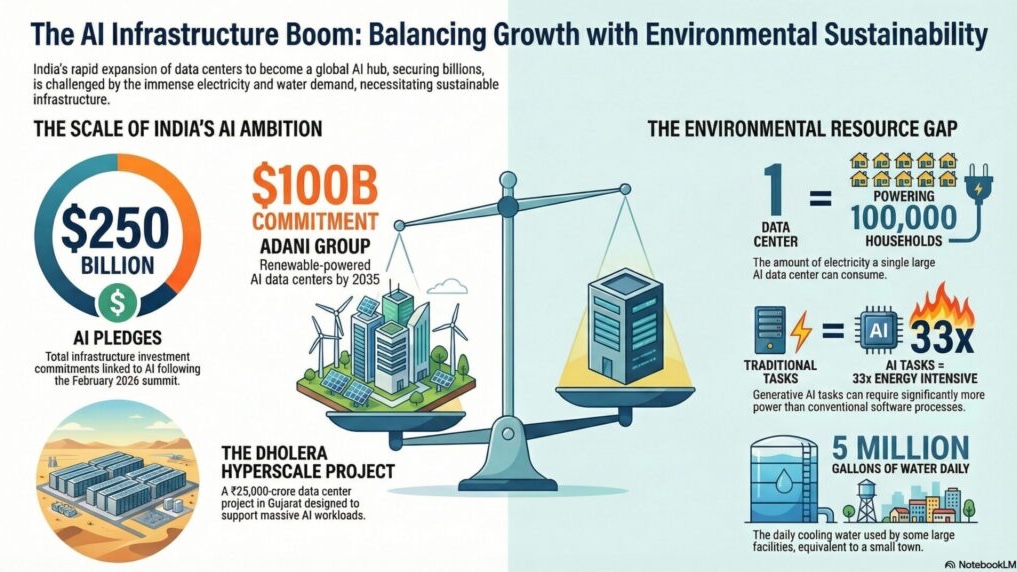
India's rapid expansion of AI-ready data centres is transforming major urban corridors into digital powerhouses. However, surging electricity demands and heavy water consumption are triggering intense environmental scrutiny across key tech hubs.
Reading this article: 0s
News in 60 words
~150-word AI digest in one read
Thesis, bullets, quote & takeaway — slogan stays "60 words"
1h ·5 min read· 0 · 0 · 0
Full story
Generative artificial intelligence is reshaping India's digital economy at an unprecedented pace. From enterprise cloud adoption to indigenous large language models, the demand for compute power has triggered a massive building spree of data centre campuses across the country.
While this boom solidifies India's status as a global technology engine, it brings significant infrastructural friction to the surface. Microsoft recently launched a new data centre region in India to handle soaring enterprise AI workloads. At the same time, mega-projects face public and regulatory scrutiny over severe water consumption, land acquisition disputes, and proximity to sensitive wildlife zones. The central challenge facing policymakers and tech leaders is stark: how can India scale its AI infrastructure without straining local natural resources?
The Scale of the Boom: From Megawatts to Gigawatts
India’s data centre footprint is moving away from traditional enterprise hosting toward hyper-dense AI facilities. Historically, data centres operated at lower rack densities suited for standard web applications. Today, specialized compute clusters running NVIDIA H100 and A100 GPUs require vastly higher power and cooling configurations.
Key clusters across India are witnessing intense development activity:
- Navi Mumbai (Maharashtra): The largest hub in the country, leveraging sea cable landings and proximity to sub-stations in Airoli and Rabale.
- Hyderabad (Telangana): Emerging as a hyper-scaler favorite due to proactive state data centre policies and reliable grid connections.
- Chennai (Tamil Nadu): A major gateway for international submarine cables with dense park developments in Siruseri.
- Greater Noida (Uttar Pradesh): Serving Northern India's enterprise and government cloud demand.
Industry projections indicate that India's operational capacity will jump from roughly 800 megawatts (MW) to over 2.5 gigawatts (GW) within the next three years. This rapid expansion demands unprecedented commitments of land, power, and water.
The Power Appetite of Generative AI
Traditional data centre racks typically consume between 4 kW to 10 kW of power. In contrast, high-density AI clusters require anywhere from 30 kW to over 80 kW per rack. This exponential step-up puts immense pressure on state electricity distribution companies (DISCOMs) like MSEDCL in Maharashtra and TGSPDCL in Telangana.
Training a single large AI model consumes as much electricity as hundreds of average urban Indian homes use in an entire year. During peak summer periods, when domestic cooling loads spike grid demand, data centre clusters require continuous base-load power. To maintain 99.999% uptime, facilities rely on massive industrial diesel generators for emergency backup, raising localized emission concerns.
To manage costs and meet sustainability goals, hyper-scalers are attempting to secure Power Purchase Agreements (PPAs) under India's Green Energy Open Access Rules. These regulations allow large consumers to source renewable energy directly from solar and wind developers. However, matching round-the-clock AI operations with variable solar and wind generation remains a complex engineering challenge that requires utility-scale battery energy storage systems (BESS).
Water Crisis and Environmental Hurdles
While power availability dominates capacity planning discussions, water consumption has emerged as a major environmental flashpoint. Traditional data centres use air-cooling systems, but high-density AI server racks generate intense heat that often demands water-intensive evaporative cooling towers.
A large-scale data centre can consume millions of litres of water daily to maintain safe operating temperatures inside the server halls. In water-stressed regions near major metro areas, diverting municipal or groundwater reserves to cool server farms creates tension with local residents and agricultural communities.
Environmental clearance disputes are becoming more frequent. Large-scale data centre park proposals have faced delays due to their proximity to forested areas, wildlife buffers, or critical catchment zones. Regulatory bodies are beginning to scrutinize Power Usage Effectiveness (PUE) and Water Usage Effectiveness (WUE) metrics before granting environmental approvals.
To mitigate water risks, operators are beginning to explore alternative cooling technologies:
- Direct-to-Chip Liquid Cooling: Circulates dielectric fluid or treated water through cold plates attached directly to the processors, reducing overall fluid volume.
- Immersion Cooling: Submerges entire server blades in non-conductive liquid baths, offering high thermal efficiency without continuous evaporative water loss.
- Recycled Wastewater Use: Utilizing tertiary-treated water from Sewage Treatment Plants (STPs) rather than freshwater supplies.
While effective, retrofitting older facilities or building advanced liquid-cooled data centres requires significantly higher initial capital expenditure, adding millions of rupees per megawatt to construction budgets.
Navigating Policy, Green Tariffs, and State Incentives
Recognizing the economic impact of cloud infrastructure, several state governments offer aggressive incentives through dedicated Data Centre Policies. Benefits often include stamp duty exemptions, electricity duty waivers, and subsidized land allotments.
However, regulatory frameworks are evolving to incentivize sustainable design choices:
- Draft National Data Centre Policy: Encourages the establishment of Data Centre Parks equipped with dedicated green energy supply corridors.
- Green Energy Tariffs: State utilities offer specialized green tariffs allowing operators to pay a small premium for 100% renewable grid allocation.
- Building Code Standards: Municipal authorities are pushing for IGBC (Indian Green Building Council) certification for new commercial infrastructure.
Forward-thinking operators are building facilities in secondary locations with access to nuclear, hydro, or solar resources, moving heavy compute workloads away from congested metro grids.
The Path Forward for Sustainable AI Infrastructure
India’s ambition to become a global AI engine depends heavily on building sustainable digital infrastructure. Achieving this balance requires deliberate action from enterprise buyers, infrastructure developers, and government bodies.
Developers must prioritize water-neutral or water-positive designs from the ground up, moving away from simple evaporative cooling towers in arid zones. Tech companies must also align their workload schedules with peak renewable power generation windows, optimizing training runs when solar energy production is highest.
Through clear regulatory guidelines, intelligent site selection, and adoption of direct-to-chip cooling methods, India can power the next generation of AI without compromising its environmental goals.
Frequently Asked Questions
How much more power does an AI data centre require compared to a traditional facility?
AI server racks require up to 5 to 8 times more power than standard cloud infrastructure, driven by high-performance GPU clusters that generate substantial thermal output.
What are state DISCOMs doing to support green data centres?
State electricity utilities offer specialized green power tariffs and enable long-term Power Purchase Agreements (PPAs) under national Open Access rules, allowing operators to draw power directly from renewable installations.
Why is liquid cooling becoming essential for new AI hubs in India?
Liquid cooling, including direct-to-chip and immersion systems, removes heat far more efficiently than air cooling, reducing both overall power consumption and localized water usage in warmer Indian climates.
Support creators
Enjoyed this deep dive into India's tech ecosystem? Support independent technology journalism on ContentVerse India by tipping our authors.
Was this helpful?
Your feedback helps us improve content for everyone.
Liked this piece?
Tip Dhananjay for the work
100% goes to the creator. Send a one-time tip in rupees and back the writing you love.
Dhananjay Singh
0 followers · 0 blogs
Creator on ContentVerse. Building, writing, and shipping in public.
0 followers


Discussion