
Is Coding Dead? How Indian Engineers Can Pivot from Syntax to AI Orchestration
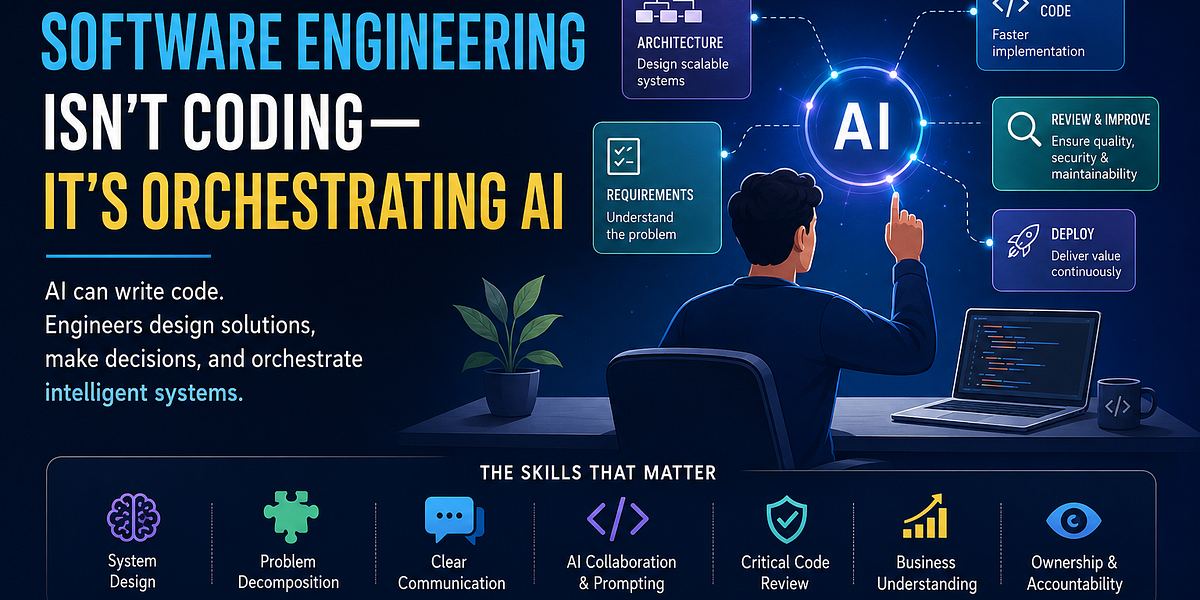
The rise of AI coding tools is transforming software engineering roles across India's IT hubs. Rather than writing repetitive syntax, developers must shift toward AI orchestration, system architecture, and domain-driven problem solving.
Reading this article: 0s
News in 60 words
~150-word AI digest in one read
Thesis, bullets, quote & takeaway — slogan stays "60 words"
2h ·5 min read· 0 · 0 · 0
Full story
The Great Syntax Shift in Indian Tech Hubs
For nearly three decades, the Indian IT ecosystem built its foundation on syntax mastery. Learning Java, C++, or Python syntax was the golden ticket to securing lucrative roles in Bengaluru, Hyderabad, Pune, and Gurugram. However, recent developments in Generative AI have sparked an existential debate across software engineering circles.
Industry leaders have fueled this conversation. Debates ignited by Anthropic co-founders regarding the automated future of software development, alongside Meta CEO Mark Zuckerberg highlighting AI-assisted code generation through initiatives like Muse Code AI, suggest that writing raw code line-by-line is rapidly becoming a legacy skill.
Does this mean coding is dead? Not quite. But the act of manually writing routine boilerplate code is dying. To remain indispensable, Indian engineers must pivot from basic syntax creation to high-level AI orchestration.
Understanding AI Orchestration vs. Traditional Coding
To navigate this career transition, developers must understand the fundamental difference between traditional coding and AI orchestration.
Traditional coding relies on memorizing syntax, writing algorithms, debugging runtime exceptions, and manually wiring database calls. An engineer spends 70% of their time typing and debugging routine logic, and 30% thinking about system architecture.
AI orchestration flips this dynamic completely:
- Context Management: Supplying AI models with the precise domain rules, codebase schemas, and API constraints required to generate clean output.
- System Architecture: Designing distributed systems, microservices, and queue management that AI tools can populate with reliable code.
- Multi-Agent Coordination: Using frameworks like LangChain, LlamaIndex, or AutoGen to chain multiple specialized AI models together to complete end-to-end tasks.
- Verification & Security: Auditing AI-generated code for edge-case vulnerabilities, memory leaks, and compliance issues like GDPR or India's DPDP Act.
In this modern paradigm, the engineer transitions from a bricklayer to an architect.
The Changing Realities of India's Tech Job Market
Major Indian IT services firms like TCS, Infosys, and Wipro, along with over 1,600 Global Capability Centers (GCCs) based in India, are radically altering their hiring strategies. The traditional model of deploying large teams of junior engineers to write standard CRUD (Create, Read, Update, Delete) APIs is rapidly shrinking.
Recruitment data across Indian job portals reveals a distinct divergence in salary benchmarks and demand:
- Pure Syntax Coders: Entry-level roles focusing solely on manual coding face stagnant salaries (often ranging around ₹3.5 Lakhs to ₹5 Lakhs per annum) with reduced hiring volume.
- AI Orchestration Engineers: Software engineers who understand Retrieval-Augmented Generation (RAG), vector databases, and system integration command packages between ₹18 Lakhs and ₹35 Lakhs per annum at mid-level tiers.
Companies no longer pay top tier salaries for someone who can write a sorting algorithm from scratch. They pay for engineers who can build complex, fault-tolerant financial pipelines—such as a real-time UPI transaction routing engine—by orchestrating AI tools to write, test, and deploy the code in a fraction of the time.
A 4-Step Blueprint to Pivot Your Career Today
If you are currently working as a software developer, tester, or engineering student in India, here is how you can systematically transition into an AI Orchestration Specialist.
1. Shift from Syntactical Fluency to Structural Fluency
Stop spending months memorizing fringe syntax nuances of programming languages. Instead, focus heavily on software design patterns, database indexing, networking protocols (gRPC, WebSockets), and cloud computing infrastructure (AWS, Azure, or Google Cloud).
2. Master the Generative AI Developer Toolchain
Move beyond using ChatGPT solely as a search engine. Integrate advanced AI development environments directly into your workflow:
- IDE Assistants: Gain deep proficiency with Cursor, GitHub Copilot, and Amazon Q.
- Frameworks: Learn to build orchestration workflows using LangChain, CrewAI, and LlamaIndex.
- Vector Infrastructure: Understand how vector databases like Pinecone, Qdrant, or Milvus index context for real-time application retrieval.
3. Develop Deep Business Domain Expertise
AI can generate code, but it does not understand localized business nuances. In India's fast-growing digital economy, deep domain knowledge in Fintech (NPCI protocols, Account Aggregators), Healthtech (ABDM integration), or Quick-Commerce logistics gives you an irreplaceable edge. When you combine domain mastery with AI tools, you produce production-ready solutions faster than entire legacy teams.
4. Practice AI-Driven Test and Security Auditing
Because AI models can produce subtle logic hallucinations, code auditing is now a critical skill. Learn how to write robust automated test suites, conduct static security analysis, and perform stress tests on AI-assisted codebases.
Frequently Asked Questions
Will entry-level coding jobs disappear completely in India?
Entry-level jobs are not disappearing, but their responsibilities are changing. Companies now expect fresh graduates to deliver full-stack features using AI assistants rather than working solely on isolated, low-complexity coding tasks.
What programming languages should I focus on in the AI era?
Python remains essential due to its dominance in AI libraries, vector search, and data processing. JavaScript/TypeScript also remains crucial for full-stack integration and building modern web orchestration interfaces.
How can I showcase AI orchestration skills on my resume?
Highlight projects where you built end-to-end applications using AI toolchains. Mention experience with RAG pipelines, multi-agent frameworks, vector search implementations, and quantifiable productivity improvements achieved through automated workflows.
Conclusion
Coding is not dead, but the era of the pure syntax typist has officially come to a close. For Indian software engineers, this shift represents a massive opportunity to move up the value chain. By embracing AI orchestration, system design, and domain-specific engineering, you can build powerful software faster and position yourself at the forefront of the global tech industry.
Support creators
If you found this career guide helpful, consider tipping the author on ContentVerse India to support more in-depth technology analysis.
Was this helpful?
Your feedback helps us improve content for everyone.
Liked this piece?
Tip Dhananjay for the work
100% goes to the creator. Send a one-time tip in rupees and back the writing you love.
Dhananjay Singh
0 followers · 0 blogs
Creator on ContentVerse. Building, writing, and shipping in public.
0 followers
Discussion