
Is our Sun dying? The solar system could be destroyed 100 times faster than previously thought, new study…
Our Sun, the ancient, stubborn, and, for most of us, reassuringly eternal star, has been at the heart of the Solar System for about 4.6 billion years, as old as
(2h)4 min read 0 0 0
Creator on ContentVerse. Building, writing, and shipping in public.
Reading this article: 0s
News in 60 words
~150-word AI digest in one read
Thesis, bullets, quote & takeaway — slogan stays "60 words"

Full story
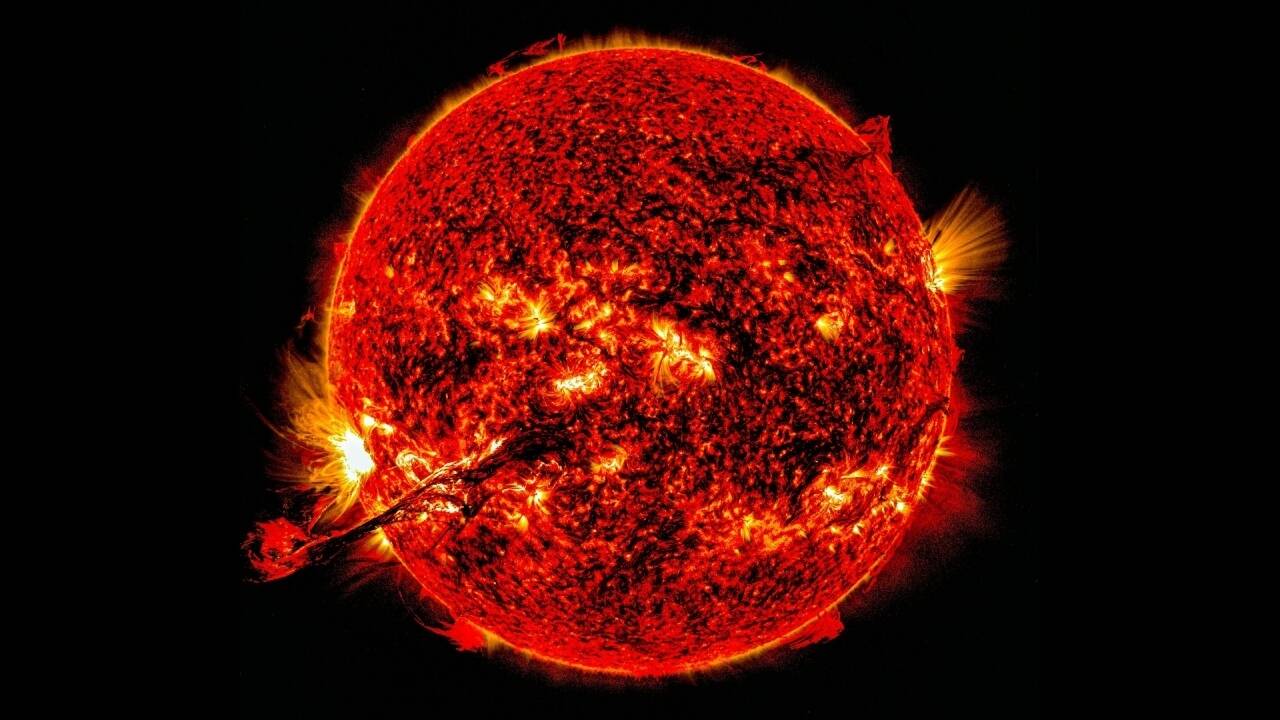
Our Sun, the ancient, stubborn, and, for most of us, reassuringly eternal star, has been at the heart of the Solar System for about 4.6 billion years, as old as any home we’ll ever know. It’s easy to believe it will keep shining forever.
But like every star, the Sun is on borrowed time, ticking through its own lifecycle whether we like it or not. For years, astronomers painted a familiar picture: Someday, far in the future, the Sun will run out of hydrogen fuel, balloon into a red giant, shed its outer layers, and end up as a fading white dwarf.
The planets, especially the big gas giants like Jupiter and Saturn, would keep drifting around the dying star for tens or even hundreds of billions of years, everything orbiting peacefully in cosmic slow-motion. It all seemed pretty orderly.
Turns out, things might get messy a lot sooner. In fact, a new study points in that direction.
What does the study say?In a new study in The Astrophysical Journal Letters, a team of astrophysicists like Konstantin Batygin, Jim Fuller, and Fred C. Adams suggests that the Solar System’s final act could be a lot more chaotic.
The Sun, as it dies, probably won’t shed its mass smoothly. Instead, it’ll lose matter in unpredictable bursts and jolts, each one giving a tiny “kick” to itself and, in turn, disturbing the planets swirling around it.
Is the Sun dying?Sure, but not in a way that means you need to panic today. This is stellar evolution, not an immediate disaster.
We’ve still got about five billion good years before the real trouble starts. The intrigue here is what comes later, long after the Sun’s hydrogen is spent and Earth as we know it is gone.
Why could the Solar System be destroyed faster than expected?Here’s where the new study shakes things up: The researchers ran hundreds of computer simulations, letting Jupiter, Saturn, Uranus, and Neptune loose in the aftermath of a turbulent, rapidly shrinking Sun. The results are quite astonishing: in about 90% of their scenarios, the outer Solar System went unstable within three billion years after the Sun turned into a white dwarf, which is way faster than the long-term, slow-fade scenario many believed.
In lots of those simulations, things started to unravel even before the Sun had finished its transformation. Why?Because the Sun’s “mass loss” isn’t neat and gentle.
Sometimes it pushes out material in uneven, short-lived bursts: a little nudge here, a little rocket boost there. Every time this happens, the Sun shakes up its gravitational grip, slinging the outer planets off their old tracks.
Orbits stretch, wobble, and cross, making once-steady planets into cosmic bumper cars. Sometimes, a planet might even get flung off, lost to interstellar space as a rogue wanderer.
In other runs, Uranus and Neptune swapped spots, a tangled dance of gravitational luck. The takeaway isn’t that every planet will crash, collide, or get ejected.
These are simulations, not destiny. But it does suggest that the tranquil afterlife of the Solar System is more “cosmic mosh pit” than “eternal slow waltz,” and way less stable over the long term.
What will happen to Earth when the Sun dies?Well, our home faces a more immediate, though still distant, end. In about five billion years, the Sun will begin to swell dramatically, likely swallowing Mercury, Venus, and maybe Earth.
Even if our planet somehow escapes destruction by engulfment, life’s days are numbered. As the Sun grows hotter and brighter, Earth’s surface will be scorched, losing its water and atmosphere long before the Sun’s big finale.
However, none of this changes your everyday sunrise — at least immediately. The Sun’s getting older, but it’s not about to wink out.
The research matters for other reasons. Many stars end their lives as white dwarfs, and astronomers are discovering that planetary systems can be surprisingly unstable when their stars go through these wild mass-loss episodes.
Maybe that explains why “dead” stars often lack surviving planets nearby, or why some systems dissolve in chaos while others hold together. Ultimately, what the study tells us is that things that appear stable, for billions of years, even, aren’t guaranteed to stay that way forever.
Our Solar System, familiar and serene for now, holds seeds of chaos in its future. It’s a humbling reminder: the universe is always more complex and surprising than it first appears.
Get the latest movie news, reviews, and celebrity updates.
Was this helpful?
Your feedback helps us improve content for everyone.
Liked this piece?
Tip Dhananjay for the work
100% goes to the creator. Send a one-time tip in rupees and back the writing you love.
Dhananjay Singh
3 followers · 477 blogs
Published 22 Oct 2026, 5:30 am IST
Creator on ContentVerse. Building, writing, and shipping in public.
Reviewed by the ContentVerse India editorial team. Educational pages are not personalised advice.
View full profile3 followers
Discussion