
IT Hiring vs AI: How India's Tech Professionals Can Future-Proof Careers
As generative AI automates routine coding and testing tasks, Indian technology professionals face a pivotal career shift. Here is a practical roadmap for developers, QA engineers, and tech leads to navigate the evolving IT landscape and thrive in AI-first roles.
Reading this article: 0s
News in 60 words
~150-word AI digest in one read
Thesis, bullets, quote & takeaway — slogan stays "60 words"
(1h)7 min read 0 0 0
Creator on ContentVerse. Building, writing, and shipping in public.

Full story
the state of Indian IT outsourcing is undergoing its most dramatic transformation since the Y2K boom. For decades, the Indian technology sector built its global reputation on cost-effective scale, providing millions of software engineers for application maintenance, manual testing, and legacy system migration. Today, generative AI and large language models (LLMs) are automating these exact entry-level, syntax-heavy tasks.
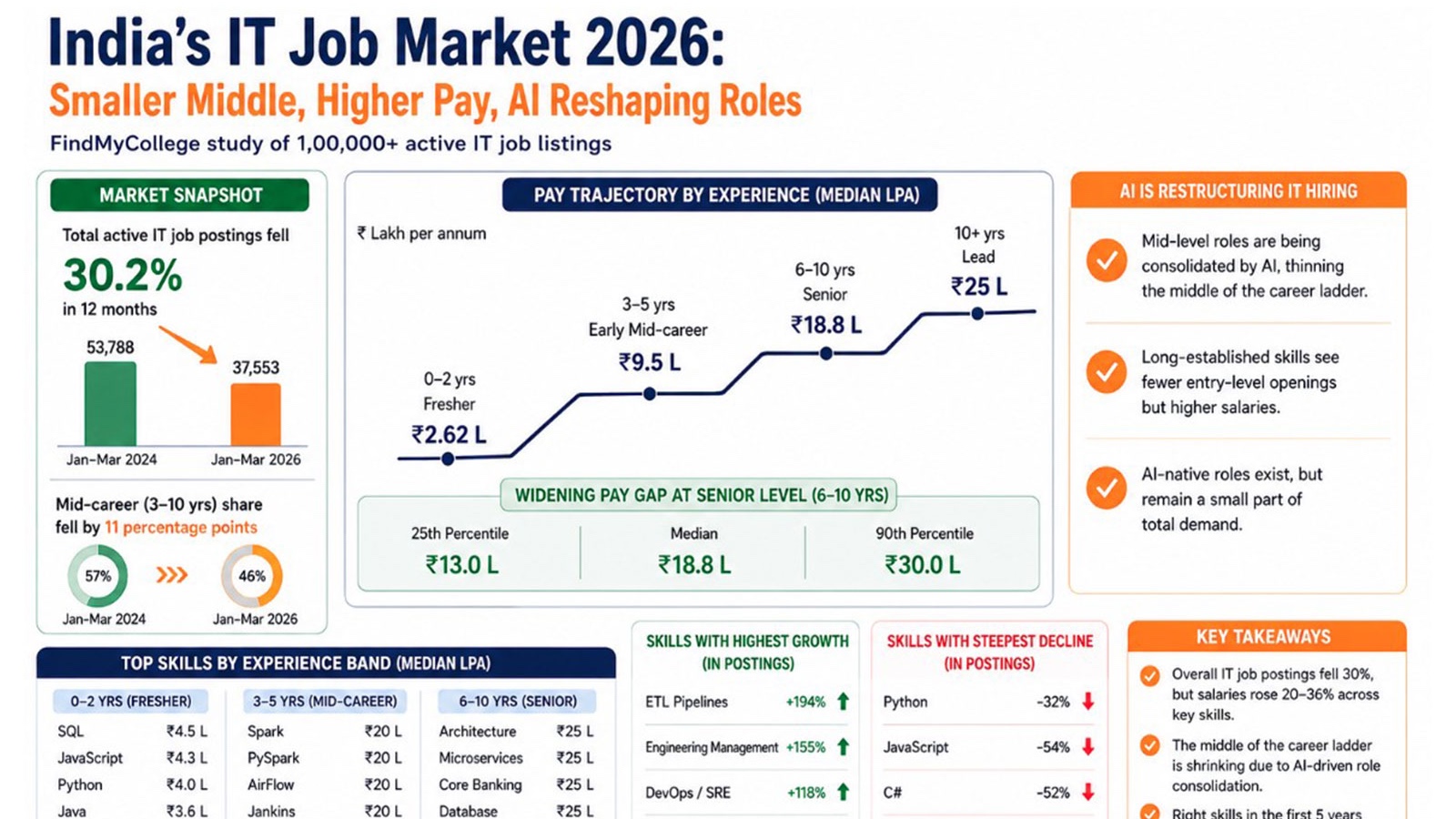
From multinational capability centers in Bengaluru's Manyata Tech Park to agile startups in Hyderabad's HITEC City and Pune's Hinjawadi, hiring managers are changing their fundamental criteria. They are no longer asking candidates simply, "Can you write Java code or execute SQL queries?" Instead, the question is, "How effectively can you use AI tools to design, orchestrate, and deploy complex systems?" This shift is not a narrative of mass job destruction; it is a rapid migration in human value. IT professionals who master this transition will command premium salaries, while those clinging to traditional service-based paradigms face career stagnation.
The Changing Paradigm of Indian IT Recruitment
Traditional IT service delivery models relied heavily on the "pyramid strategy"—employing large cohorts of junior engineers managed by a smaller tier of senior architects. Major Indian IT services giants, including TCS, Infosys, Wipro, and HCLTech, are shifting away from pure headcount-driven revenue models toward outcome-based, AI-assisted delivery.
Routine CRUD (Create, Read, Update, Delete) operations, basic boilerplate code, and standard unit tests that once occupied teams of entry-level developers can now be generated in seconds using enterprise-grade AI assistants like GitHub Copilot, Amazon Q, or internal proprietary models. Consequently, campus recruitment across IITs, NITs, and Tier-2 engineering colleges in cities like Coimbatore or Jaipur is undergoing a major structural recalibration.
Recruiters are reducing their intake for generic coding profiles and raising the bar for initial hiring. Key shifts in the Indian IT talent market include:
- Contraction of Legacy Delivery Roles: Manual software testing, L1/L2 application support, and basic maintenance roles are experiencing reduced headcount allocations across top service providers.
- Heightened Bar for Entry-Level Engineers: Campus hires are expected to possess strong foundational concepts in data structures, system design, and AI tool integration rather than raw language syntax memorization.
- Transition to Outcome-Based Client Billing: Service providers are renegotiating enterprise contracts from time-and-materials (T&M) pricing to outcome-based pricing, driving teams to automate routine tasks to preserve operating margins.
From Code Writers to System Orchestrators
For a software engineer sitting in a Hyderabad cubicle or working remotely from Tier-2 cities like Kochi or Indore, AI should not be viewed as a threat, but as an intellectual amplifier. Just as financial spreadsheets did not eliminate accountants, AI programming co-pilots do not eliminate developers. They raise the baseline of expected performance.
Writing basic code syntax is becoming a commoditized activity. The true economic value in software engineering has moved upstream toward system architecture, security compliance, data privacy, and requirements engineering. Tech professionals must migrate from being manual code writers to system orchestrators.
Consider a mid-tier banking application migration project. An AI assistant can convert legacy COBOL or Java 8 backend modules into microservices within minutes. However, an engineer must audit those generated microservices for zero-day security vulnerabilities, ensure strict compliance with India's Digital Personal Data Protection (DPDP) Act 2023, and optimize cloud infrastructure costs on AWS or Microsoft Azure.
Key Responsibilities of the Modern AI-Assisted Developer:
- Prompt Engineering and Context Injection: Crafting precise prompts, systemic instructions, and context windows to guide AI model outputs without hallucination.
- Architectural Oversight: Validating system resiliency, latency, API rate-limiting, and distributed database consistency across cloud microservices.
- Data Governance and Security: Safeguarding enterprise data pipelines against prompt injection attacks, sensitive data exposure, and intellectual property leakage.
The GCC Surge: Where the High-Value Jobs Are Moving
While traditional outsourcing firms optimize their talent pyramids, Global Capability Centers (GCCs) in India are experiencing unprecedented expansion. Cities like Bengaluru, Gurugram, Hyderabad, and Chennai host over 1,600 GCCs for global powerhouses such as Target, Walmart, JPMorgan Chase, and Boeing.
Unlike classic IT offshore centers focused purely on cost arbitrage, modern GCCs operate as core innovation engines. These capability centers are actively building proprietary machine learning models, cloud native architectures, and domain-specific generative AI solutions.
This shift directly impacts developer compensation and hiring standards. While starting salaries for generic IT service roles have hovered around ₹3.5 LPA to ₹4.5 LPA for over a decade, GCC roles for engineers skilled in AI engineering, cloud system design, and MLOps frequently start at ₹8 LPA to ₹14 LPA for freshers, scaling rapidly to ₹20–35 LPA for mid-level professionals.
To capture these opportunities, candidate evaluation has shifted. Technical interviews at GCCs prioritize open-source GitHub contributions, hands-on architectural design discussions, and real-world problem-solving over passive certifications.
Strategic Upskilling Blueprint for Indian Developers
Thriving in an AI-first tech sector requires a structured, multi-disciplinary approach to upskilling. Rather than trying to learn every new AI tool launched each week, tech professionals should build core competencies across foundational layers.
1. Applied Generative AI and RAG Architecture
Moving beyond basic API calls, developers should master Retrieval-Augmented Generation (RAG). Learn how to connect open-source models like Llama 3 or Mistral to custom enterprise databases using vector databases such as Pinecone, Milvus, or Qdrant. Enterprise applications rely on RAG to deliver accurate, context-aware responses without costly full-model retraining.
2. MLOps and Model Deployment
Building an AI model in a Jupyter Notebook is only the first step. Engineering teams need MLOps specialists who can package models into scalable Docker containers, deploy them on Kubernetes, monitor drift, and maintain low latency using frameworks like vLLM or Ollama.
3. Cloud Native and Infrastructure Automation
AI applications demand high compute capacity and optimized data pipelines. Developing expertise in Terraform, AWS SageMaker, Azure ML, and serverless compute models ensures you can manage the full lifecycle of intelligent applications.
4. Deep Domain Expertise
Pure technical skills face higher risks of automation than domain-bound context. Coupling software architecture skills with deep domain knowledge in Indian FinTech (UPI integration, core banking), HealthTech, or Supply Chain logic creates an irreplaceable skill profile that AI cannot easily model.
Engineers can use government and industry initiatives like NASSCOM FutureSkills Prime or open-source community meetups in major hubs to gain structured exposure and peer-to-peer insights.
Navigating Career Transitions for Testing and Non-Coding Roles
The impact of AI automation is felt acutely in manual software quality assurance (QA), level-1 IT operations, and traditional project management. However, professionals in these domains do not need to restart their careers from scratch. Instead, they can pivot into adjacent, high-demand niches.
- Manual Testers to AI QA Engineers: Shift focus from writing repetitive manual test cases to AI model evaluation, synthetic data generation, and automated edge-case benchmarking.
- Business Analysts to AI Product Managers: Combine customer requirements gathering with an understanding of AI feasibility, model capabilities, and ethical guardrails to bridge business strategy with technical execution.
- System Administrators to Cloud MLOps Specialists: Expand infrastructure knowledge from traditional virtual machines to GPU cluster management, data pipeline orchestration, and cost-efficient cloud scaling.
Frequently Asked Questions
Will generative AI completely replace entry-level IT jobs in India?
No, generative AI will not eliminate entry-level roles entirely, but it has permanently raised entry barriers. Employers now expect fresh graduates to handle higher-level tasks earlier in their careers by utilizing AI assistants. Entry-level engineers who demonstrate strong software architecture fundamentals and hands-on experience with AI tools will continue to find solid career opportunities.
Which certifications carry real weight with Indian tech recruiters?
While certifications demonstrate commitment, hiring managers in top Indian GCCs and product companies prioritize practical execution over certificates. Cloud certifications from major platforms (like AWS Certified Solutions Architect or Azure AI Engineer) hold value, but a publicly accessible GitHub repository featuring production-ready projects and open-source contributions remains the strongest asset.
How can non-coding IT professionals transition into AI roles?
Non-coding professionals should use their domain and business process experience. Quality analysts, business managers, and operations leads can pivot into AI Quality Engineering, AI Product Management, or AI Governance. Focus on learning tool capabilities, prompt design, data validation, and AI ethics rather than deep machine learning mathematical theory.
Takeaway
The rapid evolution of artificial intelligence across India's IT landscape is not a threat to technology careers; it is a catalyst for professional growth. By transitioning from repetitive task execution to high-level architectural design, system orchestration, and domain-driven innovation, Indian tech professionals can future-proof their careers for the decade ahead. The future of Indian technology belongs to those who partner with AI to solve complex, real-world problems.
Support creators
If you found this career guide valuable, consider tipping the author on ContentVerse India to support independent technology journalism.
Was this helpful?
Your feedback helps us improve content for everyone.
Liked this piece?
Tip Dhananjay for the work
100% goes to the creator. Send a one-time tip in rupees and back the writing you love.
Dhananjay Singh
3 followers · 111 blogs
Published 20 Oct 2026
Creator on ContentVerse. Building, writing, and shipping in public.
Reviewed by the ContentVerse India editorial team. Educational pages are not personalised advice.
View full profile3 followers


Discussion