
LIC Stake Sale at 10% Discount: Should Retail Investors Buy?
The Indian government's proposed stake sale in LIC offers retail investors an enticing 10% discount on market prices. This analysis breaks down whether the valuation, embedded value growth, and dividend yield make it a sound addition to your portfolio.
Reading this article: 0s
News in 60 words
~150-word AI digest in one read
Thesis, bullets, quote & takeaway — slogan stays "60 words"
1h ·6 min read· 0 · 0 · 0
Full story
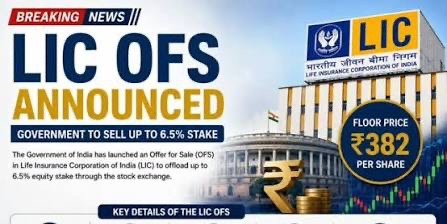
The Ministry of Finance's proposal to divest an additional stake in the Life Insurance Corporation of India (LIC) through an Offer for Sale (OFS) has re-ignited intense debate across Dalal Street. To make the offer attractive to everyday households, the government has structured a 10% discount for retail investors.
Following its massive ₹21,000-crore Initial Public Offering (IPO) in May 2022, LIC’s stock performance has had a bumpy ride. While early allotment holders faced listing losses, operational restructuring and dividend payouts have gradually reshaped investor sentiment. If you are an Indian retail investor considering whether to bid for discounted shares through apps like Zerodha, Groww, or Angel One, understanding the underlying numbers is vital before placing your bid.
Understanding the LIC Offer for Sale (OFS) and Retail Discount
An Offer for Sale (OFS) is a simplified mechanism used by promoters—in this case, the President of India acting through the Central Government—to reduce their holding in a listed entity. Unlike an IPO, which issues fresh capital for company expansion, an OFS transfers existing shares directly from the promoter to the public.
To encourage widespread participation, SEBI regulations allow companies to offer a discounted price floor specifically for retail investors (individuals bidding for up to ₹2,00,000 worth of shares).
How the 10% Discount Actually Works
- Cut-Off Price: The government sets a floor price for institutional bidding on Day 1 of the OFS.
- Retail Execution: On Day 2, retail bids open. A 10% discount means if the clearing price for institutional buyers settles at ₹1,000 per share, retail investors pay ₹900 per share.
- Instant Cushion: This 10% margin provides an immediate buffer against short-term market volatility, making the risk-reward ratio more favorable on paper.
LIC Financial Health: Embedded Value and VNB Margins
When analyzing life insurance stocks, standard price-to-earnings (P/E) ratios tell only half the story. Insurance analysts rely heavily on two metrics: Embedded Value (EV) and Value of New Business (VNB) margin.
Embedded Value (EV) Realignment
At the time of its IPO, LIC’s Embedded Value stood around ₹5.4 lakh crore. Subsequent reallocations between participating and non-participating policyholder funds significantly boosted the declared EV. Today, LIC trades at a Price-to-Embedded Value (P/EV) multiple that is significantly lower than private peers like HDFC Life, SBI Life, and ICICI Prudential, which often command multiples between 2.5x and 3.5x.
Premium Mix and VNB Margins
Historically, LIC dominated the low-margin participating (Par) traditional insurance segment. In recent quarters, management has consciously shifted focus toward non-participating (Non-Par) products, term plans, and annuities.
- VNB Margin Growth: Margins have expanded from under 15% toward the 16-19% range.
- Market Share: LIC retains over 58% of the total market share in first-year premium collection across India, backed by its massive agency force of over 13 lakh active agents.
Major Advantages for Retail Buyers
- Deep Value Discount: The combined effect of low P/EV multiples and an additional 10% retail discount makes the entry valuation highly attractive compared to historical sector averages.
- High Dividend Yield: LIC has consistently declared substantial dividends. For yield-seeking retail investors in tier-2 and tier-3 cities, this provides stable income akin to fixed deposits but with potential equity upside.
- Sovereign Backing: Under Section 37 of the LIC Act 1956, sums assured and bonuses declared by LIC carry a sovereign guarantee from the Government of India, maintaining high consumer trust.
Risks and Key Challenges to Consider
Despite the reduced entry price, investing in state-owned enterprises (PSUs) comes with unique risk dynamics that retail buyers must acknowledge.
- Government Divestment Overhang: To meet SEBI’s minimum public shareholding norm of 25%, the government will need to sell further tranches over the coming years. Repeated supply influxes can cap sharp price rallies.
- Competition from Digital Channels: Private players continue to capture market share in high-margin urban segments through bank tie-ups (bancassurance) and direct digital sales platforms like Policybazaar.
- Slower Growth Rate: Due to its immense base size, LIC's premium growth rate typically lags behind nimble private sector competitors.
Who Should Buy the Discounted LIC Shares?
The decision to participate depends entirely on your financial goals and portfolio construction.
Conservative Income Seekers
If you are looking for long-term exposure to India's financialization story with a safety net of dividends, buying at a 10% discount is a sensible choice. It serves as a defensive value allocation within a multi-asset portfolio.
Growth-Oriented Tactical Investors
If you are seeking 30-40% compound annual growth rates (CAGR) or quick listing gains, LIC may disappoint. The stock's massive equity base means capital appreciation will likely be steady and gradual rather than explosive.
How to Apply for the OFS via UPI and Broker Apps
Participating in an OFS is simpler than applying for an IPO because the process takes place directly on the stock exchange trading screen.
- Log in to your Demat platform (such as Zerodha, Groww, Upstox, or ICICI Direct) during trading hours on the retail bidding day.
- Navigate to the OFS or Corporate Actions section under your dashboard.
- Select LIC OFS, enter the quantity of shares, and opt for the Cut-Off Price to ensure eligibility for the retail discount.
- Approve the UPI mandate sent to your payment app (PhonePe, BHIM, or Google Pay) before 4:00 PM on the bidding date.
Frequently Asked Questions
How is the 10% retail discount applied during an OFS?
The discount is calculated on the cut-off price determined on the institutional bidding day. When retail investors select the cut-off option, the final debit from their account automatically reflects the 10% reduced rate per share.
Can LIC policyholders claim an extra discount in the OFS?
Unlike the initial IPO, standard OFS mechanics usually feature a single retail category with a designated discount. Check the official exchange notice on BSE/NSE prior to bidding to verify if a separate policyholder reservation window is declared.
Is LIC stock suitable for long-term dividend income?
Yes, LIC’s strong cash flow generation and commitment to shareholder returns make it a consistent dividend payer, offering dividend yields that rival many traditional fixed-income instruments.
Conclusion
The 10% retail discount on LIC’s stake sale presents a compelling risk-managed opportunity for long-term, value-oriented investors. While government supply overhangs and market competition remain factors to monitor, LIC’s dominant market position, expanding margins, and stable dividend yield make this OFS a strong candidate for portfolio diversification.
Disclaimer: This is educational content, not financial advice. Equities are subject to market risks. Conduct your own research or consult a SEBI-registered financial advisor before making investment decisions.
Support creators
If you enjoyed this breakdown, consider tipping the author on ContentVerse India to support independent financial journalism.
Was this helpful?
Your feedback helps us improve content for everyone.
Liked this piece?
Tip Dhananjay for the work
100% goes to the creator. Send a one-time tip in rupees and back the writing you love.
Dhananjay Singh
0 followers · 0 blogs
Creator on ContentVerse. Building, writing, and shipping in public.
0 followers


Discussion