
Is Coding Dead in India? How AI is Reshaping Developer Careers
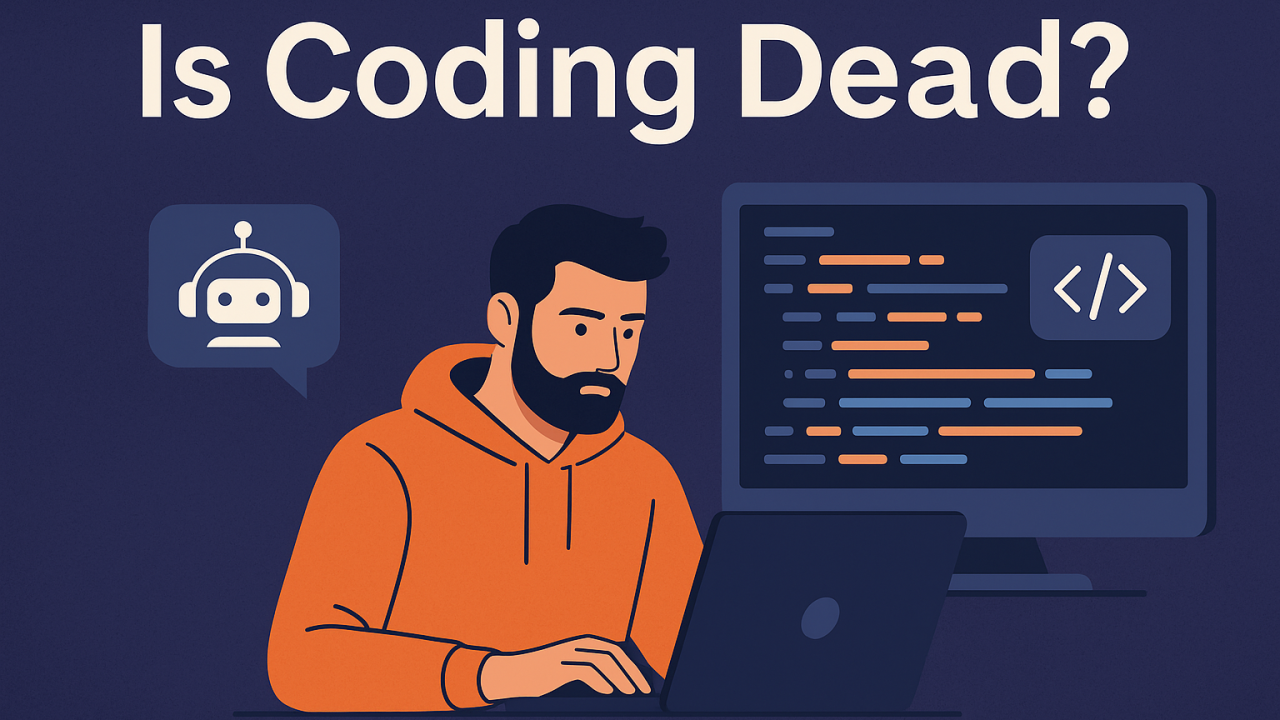
The rapid advancement of AI tools has sparked widespread speculation about the future of programming jobs, causing concern among India's vast developer community. This article explores how AI is not killing coding, but rather evolving the role of software engineers in India, demanding a new set of skills and perspectives.
Reading this article: 0s
News in 60 words
~150-word AI digest in one read
Thesis, bullets, quote & takeaway — slogan stays "60 words"
7d ·6 min read· 1 · 0 · 0
Full story
The landscape of software development is undergoing a seismic shift, driven by the relentless march of Artificial Intelligence. For India, a nation that has long prided itself on being a global IT powerhouse and a hub for millions of developers, this evolution brings both apprehension and immense opportunity. Questions like "Is coding dead?" or "Will AI take my job?" are now common anxieties echoing through tech hubs from Bengaluru to Pune.
However, a closer look reveals that AI isn't poised to eliminate coding but rather to redefine it. The core essence of problem-solving and innovation remains, but the tools, methodologies, and required skillsets are rapidly transforming. Indian developers, known for their adaptability and technical prowess, are at a critical juncture where embracing this change is not just an option, but a necessity for career longevity and growth.
The AI Revolution as a Co-pilot, Not a Replacement
Modern AI tools like GitHub Copilot, ChatGPT, and Google Gemini are fundamentally changing how developers interact with code. These tools can generate boilerplate code, suggest functions, debug errors, and even translate code between languages. This doesn't mean the human developer becomes redundant; instead, AI acts as an incredibly powerful co-pilot, augmenting productivity and allowing engineers to focus on higher-level tasks.
Consider a scenario in a Mumbai-based startup: a developer might use an AI assistant to quickly scaffold a new API endpoint, freeing up hours that would typically be spent on repetitive syntax. This acceleration means projects can be completed faster, and developers can tackle more complex architectural challenges or innovative feature development. The demand isn't for coders who can simply type out lines of code, but for engineers who can effectively orchestrate AI tools to build sophisticated systems.
Shifting Skillsets: Beyond Pure Syntax
The era where mastering a single programming language was sufficient is fading. Today, and increasingly tomorrow, the value lies in skills that complement and leverage AI. For Indian developers, this means a strategic pivot towards:
- Prompt Engineering: The ability to craft precise and effective queries for AI models to generate desired code or solutions. This is becoming a critical skill, almost a new form of programming itself.
- System Design and Architecture: As AI handles more routine coding, understanding how to design robust, scalable, and secure systems becomes paramount. Developers need to integrate AI-generated components effectively into larger architectures.
- Problem-Solving and Critical Thinking: AI can generate code, but it can't understand nuanced business requirements, anticipate edge cases, or innovate solutions to truly unique problems without human guidance.
- Debugging and Code Review: AI-generated code, while efficient, still requires human oversight for quality, security, and performance. The ability to critically review and debug AI outputs is crucial.
- Domain Expertise: Deep knowledge of specific industries (e.g., FinTech, Healthcare, Logistics) allows developers to apply AI solutions to real-world problems effectively, creating solutions that truly add value.
- Ethical AI and Security: Understanding biases in AI, ensuring data privacy, and building secure AI applications are non-negotiable skills, especially with India's evolving data protection regulations.
Emerging Roles and Opportunities in the AI Era
The fear of job displacement often overshadows the reality of job transformation and creation. AI is spawning entirely new roles and expanding existing ones within the Indian tech ecosystem. Companies in Hyderabad, Chennai, and Delhi are actively seeking talent for positions such as:
- AI/ML Engineers: Specializing in building, training, and deploying machine learning models.
- MLOps Engineers: Bridging the gap between development and operations for ML systems, ensuring seamless deployment and management of AI models.
- AI Product Managers: Defining and guiding the development of AI-powered products, understanding both technical capabilities and market needs.
- Data Ethicists/AI Governance Specialists: Ensuring AI systems are fair, transparent, and compliant with ethical guidelines and regulations.
- Prompt Engineers/AI Whisperers: Focusing on optimizing interactions with large language models and other generative AI tools.
Indian IT service giants are investing heavily in AI capabilities, reskilling their workforce, and offering AI-driven solutions to global clients, creating a robust demand for these specialized skills.
Navigating the Indian Job Market: A Proactive Approach
For freshers entering the job market and experienced professionals looking to stay relevant, proactive learning and adaptation are key. Many Indian educational institutions and private platforms are now offering specialized courses in AI and ML. Investing in certifications from platforms like NPTEL, Coursera, or edX in areas like Deep Learning, Data Science, or AI Ethics can significantly boost career prospects.
Consider participating in hackathons focused on AI solutions, contributing to open-source AI projects, or building personal projects that demonstrate your ability to integrate AI tools. For instance, a small project automating a common task using an AI API can be a powerful addition to a resume. The government's Skill India mission and NASSCOM's FutureSkills Prime initiative are also valuable resources for upskilling in emerging technologies.
Companies are increasingly looking for developers who can demonstrate not just coding proficiency, but also an understanding of how to leverage AI to solve problems and improve efficiency. This is particularly true in competitive markets like Bengaluru, where innovation is highly prized.
Frequently Asked Questions
Will AI completely replace software developers in India?
No, AI is highly unlikely to completely replace software developers. Instead, it will change the nature of their work. AI excels at repetitive, pattern-based tasks, but lacks human creativity, critical thinking, and the ability to understand complex, ambiguous business requirements. Developers who adapt and learn to work with AI will be indispensable.
What is the single most important skill for an Indian developer to acquire now?
Adaptability and a problem-solving mindset are paramount. Beyond that, the ability to effectively use and 'prompt' AI tools to generate, refine, and debug code (prompt engineering) combined with strong system design principles will be crucial. This allows developers to leverage AI's power while maintaining control and strategic oversight.
How can freshers prepare for this AI-driven development landscape?
Freshers should focus on foundational computer science principles, gain hands-on experience with AI tools like GitHub Copilot, build projects that integrate AI, and explore niche areas like MLOps or ethical AI. Pursuing internships that involve AI development or data science can provide invaluable practical exposure and a competitive edge in the job market.
Conclusion
The narrative around AI and coding in India needs to shift from fear to empowerment. AI is not the end of coding but the beginning of a more sophisticated and exciting era of software development. For Indian developers, this means an unparalleled opportunity to innovate, specialize, and contribute to cutting-edge solutions on a global scale. By embracing continuous learning, adapting to new tools, and focusing on higher-order thinking skills, India's tech talent can continue to thrive and lead in this AI-powered future.
Support creators
Was this helpful?
Your feedback helps us improve content for everyone.
Liked this piece?
Tip Dhananjay for the work
100% goes to the creator. Send a one-time tip in rupees and back the writing you love.
Dhananjay Chauhan
0 followers · 0 blogs
Creator on ContentVerse. Building, writing, and shipping in public.
0 followers
Discussion