
Startup India Fund of Funds 2.0: How Founders Can Access the ₹10,000 Cr Scheme
The Department for Promotion of Industry and Internal Trade (DPIIT) has refreshed the guidelines for the ₹10,000 Crore Startup India Fund of Funds (FFS 2.0). Learn how early-stage Indian founders can navigate the SIDBI-backed VC ecosystem to secure growth capital.
Reading this article: 0s
News in 60 words
~150-word AI digest in one read
Thesis, bullets, quote & takeaway — slogan stays "60 words"
1h ·6 min read· 0 · 0 · 0
Full story
Disclaimer: This is educational content, not financial advice.
India's ₹10,000 Crore VC Catalyst Reimagined
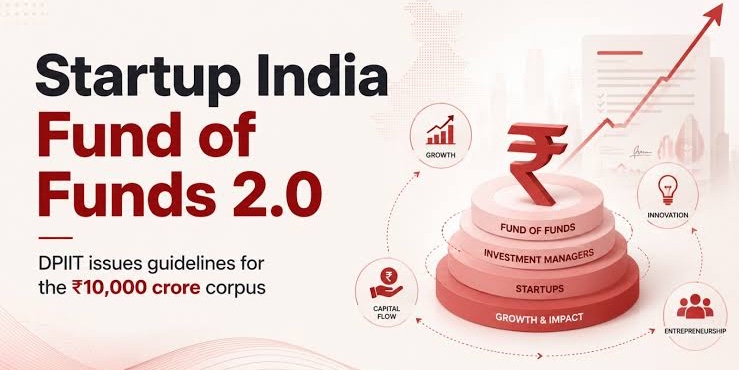
For early-stage entrepreneurs in India, securing seed and Series A capital has often felt like an uphill battle, especially during shifting macroeconomic cycles. To address structural capital gaps, the Department for Promotion of Industry and Internal Trade (DPIIT) recently released updated guidelines for the Startup India Fund of Funds 2.0 (FFS 2.0). Managing a vast corpus of ₹10,000 Crore, this flagship intervention aims to democratize venture capital distribution across the country.
Unlike traditional grant schemes, FFS 2.0 operates as a 'fund of funds' model. Rather than writing direct cheques to companies, the Small Industries Development Bank of India (SIDBI) allocates government funds into private, SEBI-registered venture capital funds. These fund managers are then mandated to invest multiples of that capital back into eligible Indian startups. Understanding how this ecosystem flows is vital for founders looking to raise institutional funding in 2025 and beyond.
What is New in Fund of Funds 2.0?
The original Fund of Funds for Startups, launched under the flagship Startup India initiative in 2016, successfully catalyzed over ₹15,000 Crore in private capital deployments. However, much of that early funding concentrated heavily in tier-1 hubs like Bengaluru, Delhi NCR, and Mumbai.
FFS 2.0 introduces refined operational benchmarks designed to address these geographic and sectoral disparities. Under the updated DPIIT framework, daughter funds (the individual VC funds receiving SIDBI backing) must follow sharper mandates:
- Deeptech & Hardware Mandate: Enhanced allocations for startups building IP-heavy technologies, quantum computing, semiconductor designs, and specialized manufacturing.
- Tier-2 and Tier-3 Penetration: Specific deployment targets requiring funds to invest outside established metro hubs, encouraging innovation in cities like Jaipur, Kochi, Indore, and Bhubaneswar.
- Diversity & Inclusion Metrics: Incentives for venture funds that actively back woman-led enterprises and underrepresented founder demographics.
How Capital Flows: From SIDBI to Your Pitch Deck
To successfully leverage FFS 2.0, founders must first understand the financial plumbing of the government initiative. You cannot submit a pitch deck directly to DPIIT or SIDBI for direct equity investment. Instead, the process works through a structured three-tier chain.
[ Government of India / DPIIT ]
            │
            ▼
 [ SIDBI (Corpus Manager) ]
            │
            ▼
 [ SEBI-Registered AIFs (Daughter Funds) ]
            │
            ▼
   [ DPIIT-Recognized Startups ]
1. Allocation to Alternative Investment Funds (AIFs)
SIDBI commits anchor capital to SEBI-registered Category I and Category II Alternative Investment Funds (AIFs). Under FFS rules, SIDBI typically contributes up to 20% to 35% of the total fund size, requiring the venture capital firm to raise the remaining 65% to 80% from private institutional investors.
2. Multiplier Deployment
For every rupee SIDBI injects into an AIF, the fund manager is legally obligated to invest a minimum of 2x that amount into eligible Indian startups. This creates a massive leverage effect, unlocking private capital alongside state support.
3. Investment into Startups
The fund managers (GPs) conduct standard commercial due diligence, negotiate valuations, and disburse equity capital directly into eligible startup bank accounts.
Key Eligibility Criteria for Startups
While individual AIFs set their own commercial return expectations, your startup must satisfy baseline government criteria to qualify for capital earmarked under the FFS 2.0 program:
- DPIIT Recognition: Your entity must hold a valid Startup India recognition certificate (DIPP number) issued by DPIIT.
- Entity Type: Must be incorporated as a Private Limited Company, a Registered Partnership Firm, or a Limited Liability Partnership (LLP) in India.
- Age and Turnover Limits: The company must be under 10 years old from the date of incorporation (extended to 12 years for deeptech ventures) and have an annual turnover not exceeding ₹100 Crore in any preceding financial year.
- Innovation & Scalability: The business must show a clear business model aimed at commercializing innovative products or services with high potential for employment generation.
4 Steps for Founders to Access FFS 2.0 Capital
If you are currently preparing for a fundraising round, align your preparation with these strategic steps to target SIDBI-backed venture funds.
Step 1: Secure DPIIT Recognition
Ensure your corporate entity is registered on the Startup India portal. The process requires your Certificate of Incorporation, brief write-ups on your business model, and GST details. Recognition is typically granted within 3 to 7 working days.
Step 2: Identify SIDBI-Empanelled AIFs
Visit the official SIDBI or Startup India portals to access the list of Category I and II AIFs that have received commitments under the Fund of Funds program. Notable funds that have historically drawn from FFS allocations include early-stage investor networks such as Blume Ventures, India Quotient, Kae Capital, and Chiratae Ventures.
Step 3: Align Pitch Materials with FFS 2.0 Priorities
When approaching fund managers, emphasize key aspects that align with FFS 2.0 goals. If your engineering team operates out of a Tier-2 city, or if your technology holds defensible patents, highlight these elements clearly in your pitch deck's executive summary.
Step 4: Prepare a Rigorous Data Room
Institutional VCs operating under SIDBI oversight face strict regulatory compliance check-ups. Ensure your corporate governance is airtight. Prepare audited financials, clean cap tables, GST filings, employee ESOP documentation, and intellectual property assignment agreements in advance.
Frequently Asked Questions (FAQs)
Q1: Can I apply directly to SIDBI for equity funding for my startup?
No. SIDBI does not make direct equity investments into individual startups under the FFS 2.0 scheme. Founders must raise capital by pitching to SEBI-registered Alternative Investment Funds (AIFs) that have received capital commitments from SIDBI.
Q2: Is FFS 2.0 a non-repayable government grant or debt?
Neither. FFS 2.0 provides equity capital through venture capital funds. In exchange for investment capital, the participating AIF will acquire equity shares or convertible instruments (like CCPS) in your company. It is standard venture equity funding, not a loan or grant.
Q3: Does DPIIT recognition guarantee that a VC fund will invest in my venture?
No. DPIIT recognition is simply a baseline eligibility requirement. The decision to invest rests entirely with the professional fund managers of the respective AIFs, who evaluate startups based on market opportunity, team capability, unit economics, and growth potential.
Navigating the Future of Early-Stage Funding
The updated Startup India Fund of Funds 2.0 framework signals a mature, institutionalized approach to building India's venture capital infrastructure. By bridging early-stage funding gaps, prioritizing deeptech, and supporting regional ecosystems, FFS 2.0 ensures that high-potential founders across the country can access institutional capital. By securing DPIIT registration and targeting SIDBI-backed VC funds, early-stage entrepreneurs can position their companies to secure long-term backing.
Support creators
If you found this operational guide useful, consider tipping the author on ContentVerse India to support independent startup analysis.
Was this helpful?
Your feedback helps us improve content for everyone.
Liked this piece?
Tip Dhananjay for the work
100% goes to the creator. Send a one-time tip in rupees and back the writing you love.
Dhananjay Singh
0 followers · 0 blogs
Creator on ContentVerse. Building, writing, and shipping in public.
0 followers

Discussion