
DPIIT's ₹10,000 Cr Fund 2.0: A Guide for Indian Startups
India's startup landscape is set for a significant boost with the government's renewed focus on the ₹10,000 Crore Fund of Funds for Startups (FFS). This guide delves into how this crucial initiative will empower Indian innovators and entrepreneurs, charting a path for accessing vital capital.
Reading this article: 0s
News in 60 words
~150-word AI digest in one read
Thesis, bullets, quote & takeaway — slogan stays "60 words"
7d ·6 min read· 0 · 0 · 0
Full story
The Indian startup ecosystem has consistently demonstrated its resilience and innovation, growing exponentially to become the third-largest globally. However, access to timely and adequate capital remains a critical challenge, especially for early and growth-stage ventures. In a significant move to address this, the Department for Promotion of Industry and Internal Trade (DPIIT) has reiterated and refined guidelines for the ₹10,000 Crore Fund of Funds for Startups (FFS), signaling a robust commitment to nurturing the nation's entrepreneurial spirit.
This renewed emphasis on the FFS, often colloquially referred to as Fund 2.0 given its evolving implementation, promises to inject much-needed liquidity into the market. For founders across cities like Bengaluru, Mumbai, Delhi, and even emerging hubs like Pune and Ahmedabad, understanding the nuances of this fund is paramount. It’s not just about capital; it’s about strategic growth, innovation, and ultimately, building a self-reliant India.
This is educational content, not financial advice.
Understanding the ₹10,000 Cr Fund of Funds for Startups (FFS)
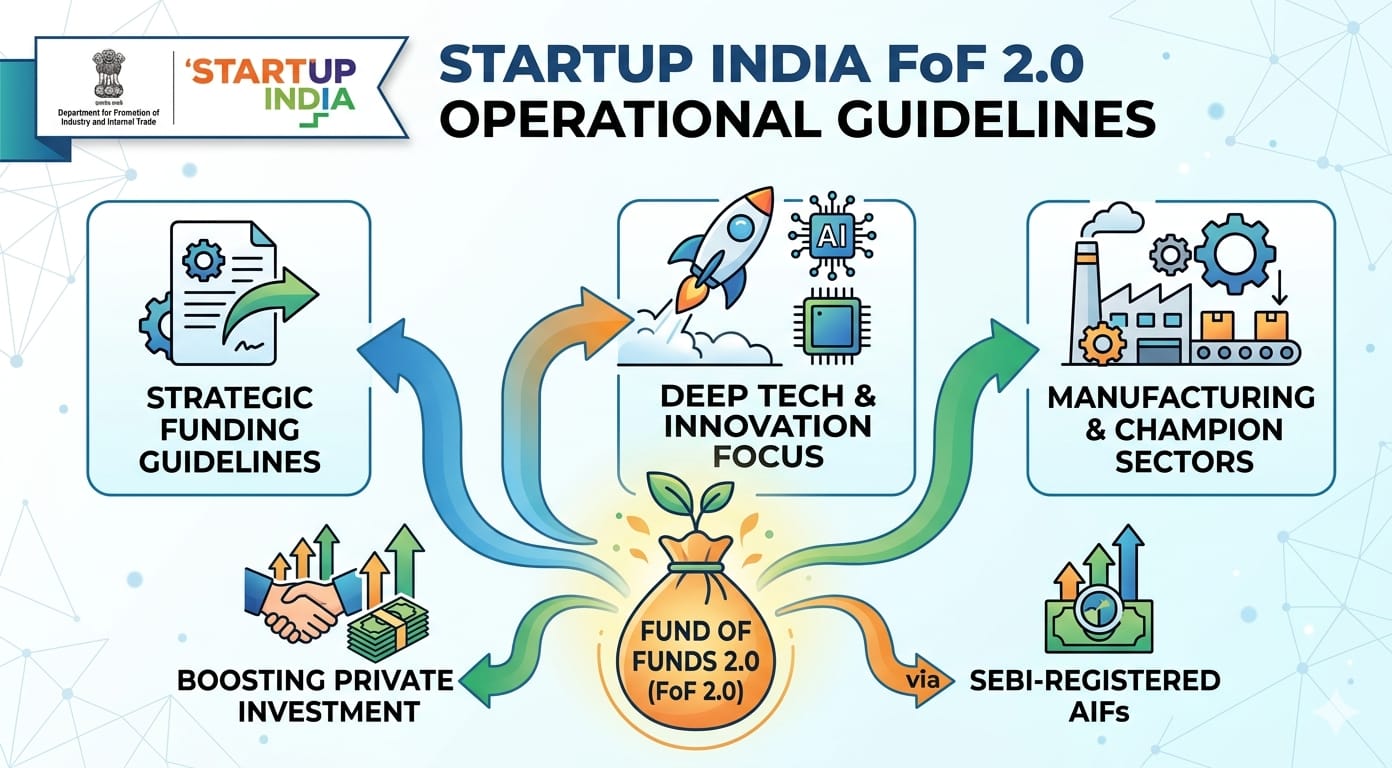
The Fund of Funds for Startups (FFS) was launched by the Government of India under the Startup India initiative in 2016, with a corpus of ₹10,000 Crore. Its primary objective is to support the funding requirements of startups by providing capital to SEBI-registered Alternative Investment Funds (AIFs). These AIFs, in turn, invest in DPIIT-recognized startups.
Managed by the Small Industries Development Bank of India (SIDBI), the FFS acts as an anchor investor, catalyzing private capital into the startup ecosystem. It addresses the 'missing middle' problem, where early-stage startups often struggle to secure follow-on funding, and also encourages the emergence of new venture capital funds in India.
The fund's structure ensures a multiplier effect. For every rupee committed by FFS, AIFs are expected to raise approximately four times the amount from other domestic and international sources, significantly amplifying the total capital available for startups.
Key Features and Eligibility Criteria
The FFS doesn't directly invest in individual startups. Instead, it operates through a 'fund of funds' model, committing capital to various AIFs, including venture capital funds, angel funds, and growth equity funds. This indirect approach allows for professional fund management and diversified investments across sectors and stages.
Eligibility for AIFs
To receive commitments from FFS, AIFs must meet stringent criteria set by SIDBI, which typically include:
- SEBI Registration: The AIF must be registered with the Securities and Exchange Board of India (SEBI) under Category I or Category II.
- Investment Strategy: A clear and compelling investment strategy focused on Indian startups, with a significant portion of their corpus dedicated to domestic investments.
- Fund Management Team: A strong, experienced, and credible fund management team with a proven track record.
- Due Diligence: A robust due diligence process for selecting investee startups.
Indirect Benefits for Startups
While startups don't directly apply to FFS, they benefit immensely by attracting investments from AIFs that have received FFS backing. For a startup to be eligible for investment from an FFS-backed AIF, it typically needs to be:
- DPIIT Recognized: The startup must be recognized by DPIIT under the Startup India initiative.
- Innovative: Demonstrating innovation in products, services, processes, or business models.
- Scalable: Possessing a scalable business model with high growth potential.
- Impact-focused: Often, AIFs look for startups that can create jobs, foster economic growth, or address social challenges.
The Application Process: Navigating Through AIFs
For an Indian startup, securing funding from an FFS-backed AIF involves a strategic approach rather than a direct application to the government. Here's how to navigate this ecosystem:
- DPIIT Recognition: Ensure your startup is officially recognized by DPIIT. This is a foundational step for accessing many government-backed benefits and investor interest.
- Develop a Robust Business Plan: Craft a compelling pitch deck and a detailed business plan that clearly articulates your problem statement, solution, market opportunity, competitive advantage, team, and financial projections. Highlight your startup's innovative edge and scalability.
- Identify Relevant AIFs: Research SEBI-registered AIFs that align with your sector (e.g., FinTech, AgriTech, SaaS, Deep Tech) and stage of development (seed, early, growth). Many AIFs publicly disclose if they are backed by FFS or similar government initiatives.
- Network and Pitch: Actively participate in startup events, demo days, and incubator/accelerator programs. These platforms offer invaluable opportunities to network with fund managers, angel investors, and venture capitalists. A strong network can open doors to pitching opportunities.
- Due Diligence and Investment: If an AIF shows interest, be prepared for a rigorous due diligence process. This involves scrutiny of your financials, legal documents, team, market, and technology. Successful completion leads to investment.
Incubators and accelerators, such as those at IITs or IIMs, often have strong ties with FFS-backed AIFs and can provide mentorship and connections, significantly enhancing a startup's chances of securing funding.
Impact on India's Startup Ecosystem: A Growth Catalyst
The ₹10,000 Crore FFS is more than just a financial injection; it's a strategic catalyst for India's startup ecosystem. Its impact is multifaceted, fostering growth across various dimensions.
Firstly, it has significantly boosted the confidence of domestic fund managers and attracted new players into the venture capital space. This has led to a proliferation of AIFs, expanding the funding options available to startups. For instance, many new sector-specific funds have emerged, catering to niches like HealthTech in Hyderabad or Electric Vehicles in Chennai.
Secondly, the fund encourages investments in Tier 2 and Tier 3 cities. As AIFs seek innovative startups beyond metropolitan centers, entrepreneurs in places like Indore, Jaipur, and Kochi find better access to capital. This decentralization of funding is crucial for inclusive economic growth and job creation across the country.
Finally, the FFS has played a pivotal role in strengthening India's position as a global startup hub. By ensuring a steady flow of capital, it enables Indian startups to innovate, scale, and compete internationally, contributing to the nation's economic resilience and technological advancement.
Common Questions About the FFS
What kind of startups does the fund ultimately support?
The FFS indirectly supports a wide range of DPIIT-recognized startups across various sectors, from FinTech and EduTech to AgriTech and Deep Tech. The focus is on innovative, scalable businesses with high growth potential that can create significant economic and social impact in India.
Is there a direct application process for startups?
No, startups cannot directly apply to the FFS. The fund operates on a 'fund of funds' model, meaning it invests in SEBI-registered Alternative Investment Funds (AIFs). Startups must seek investment from these AIFs, which then utilize the capital, partly sourced from FFS, to fund their ventures.
How does this fund differ from other government schemes like SISFS?
The FFS (Fund of Funds for Startups) is a ₹10,000 Crore corpus managed by SIDBI that invests in AIFs. The Startup India Seed Fund Scheme (SISFS), on the other hand, is a ₹945 Crore scheme that provides financial assistance directly to eligible DPIIT-recognized startups through incubators for proof of concept, prototype development, product trials, and market entry.
Conclusion
The DPIIT's ₹10,000 Crore Fund of Funds for Startups represents a cornerstone of India's commitment to fostering a vibrant and self-reliant startup ecosystem. By bolstering the venture capital landscape, it creates a robust pathway for innovative Indian startups to access crucial capital, scale their operations, and contribute significantly to economic growth and job creation.
For aspiring and existing founders, the message is clear: focus on building a strong, innovative, and scalable business. Understand the indirect nature of the FFS and strategically engage with SEBI-registered AIFs. The opportunity is immense, and with the right approach, your startup can leverage this monumental initiative to reach new heights.
Support creators
Was this helpful?
Your feedback helps us improve content for everyone.
Liked this piece?
Tip Dhananjay for the work
100% goes to the creator. Send a one-time tip in rupees and back the writing you love.
Dhananjay Chauhan
0 followers · 0 blogs
Creator on ContentVerse. Building, writing, and shipping in public.
0 followers
Discussion