
Tell me about Delhi History amcient history to moderen history
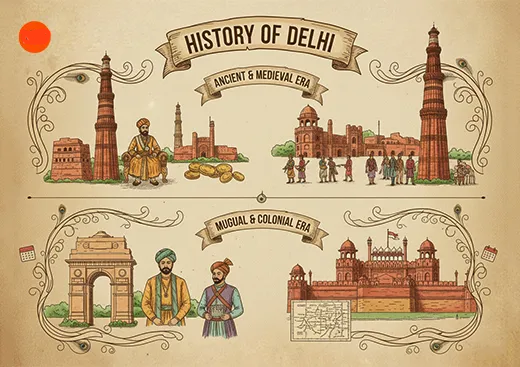
Delhi isn't just a city; it's a living palimpsest, where ancient empires lie beneath medieval forts and colonial grandeur intertwines with modern aspirations. Discover the incredible journey of a city built and rebuilt, a testament to resilience and continuous transformation.
Reading this article: 0s
News in 60 words
~150-word AI digest in one read
Thesis, bullets, quote & takeaway — slogan stays "60 words"
1mo ·8 min read· 3 · 0 · 0
Full story
Delhi: A City Forged Through Time
Delhi, the capital city of India, is more than just a sprawling metropolis; it's a living testament to millennia of human civilization, a palimpsest where layers of history are etched into its very soul. Often referred to as the "City of Cities," Delhi has been built, destroyed, and rebuilt countless times, each era leaving an indelible mark on its landscape, culture, and spirit. To walk through Delhi is to traverse time, from the mythological past of Indraprastha to the bustling modernity of New Delhi. This journey through Delhi's ancient, medieval, and modern history reveals a saga of empires, invasions, cultural syntheses, and enduring resilience.
The Ancient Roots: Indraprastha and Beyond
The earliest legends associate Delhi with Indraprastha, the glorious capital of the Pandavas in the epic Mahabharata. While archaeological evidence directly linking modern Delhi to Indraprastha remains elusive, the Yamuna river, a constant presence through Delhi's history, would have been a vital lifeline for early settlements. The earliest concrete archaeological findings point to settlements dating back to the Mauryan period (3rd century BCE). The famous Ashokan edict found near Srinivaspuri is a clear indicator of Mauryan presence, signifying Delhi's importance even then as a strategic point along trade routes.
Following the Mauryans, Delhi saw the influence of various regional powers. The Iron Pillar in the Qutb Minar complex, dating back to the 4th century CE, is a remarkable metallurgical marvel from the Gupta period, originally erected by Chandragupta II. Its presence in Delhi, albeit moved from its original location, speaks to the city's continuous, albeit sometimes fragmented, historical thread. For centuries, Delhi remained a significant, though not always dominant, regional center, witnessing the ebb and flow of smaller kingdoms before the advent of a more structured urban development.
The Rise of Medieval Delhi: Rajput Kingdoms and the Delhi Sultanate
The medieval period marked a significant turning point for Delhi, transforming it from a regional town into a powerful political and cultural hub. The Tomar Rajputs are credited with founding Lal Kot, the first of the seven cities of Delhi, in the 8th century CE. They were succeeded by the Chauhans, most famously Prithviraj Chauhan III, who expanded Lal Kot into Qila Rai Pithora. This fort city, with its formidable walls, became a symbol of Rajput power and resistance.
However, the political landscape of India was dramatically altered with the arrival of Islamic invaders. In 1192, Muhammad Ghori defeated Prithviraj Chauhan in the Battle of Tarain, paving the way for the establishment of the Delhi Sultanate. Qutb al-Din Aibak, Ghori's general, established the Mamluk dynasty in 1206, marking the beginning of a long line of Turkic and Afghan rulers who would govern from Delhi. The Qutb Minar complex, with its towering minaret, Quwwat-ul-Islam Mosque, and the Iron Pillar, stands as a monumental testament to this foundational era, showcasing early Indo-Islamic architecture.
The Delhi Sultanate saw a succession of powerful dynasties:
- The Mamluks (Slave Dynasty): Laid the groundwork for Islamic rule, establishing key administrative and architectural precedents.
- The Khiljis: Under Alauddin Khilji, Delhi expanded significantly, with the construction of Siri Fort, designed to protect the city from Mongol invasions.
- The Tughlaqs: This dynasty was prolific in city-building. Ghiyasuddin Tughlaq built Tughlaqabad, a massive fortified city, while Muhammad bin Tughlaq briefly moved the capital to Daulatabad before returning. His successor, Firoz Shah Tughlaq, founded Firozabad (Firoz Shah Kotla), focusing on public works and infrastructure.
- The Sayyids and Lodis: These later Sultanate dynasties continued to contribute to Delhi's architectural heritage, though their political power was often more localized. Notable Lodi-era structures include the Lodi Gardens tombs, showcasing a distinct architectural style.
During the Sultanate period, Delhi became a vibrant center of Islamic learning, art, and administration, attracting scholars, mystics, and artisans from across the Islamic world. This era fundamentally shaped Delhi's demographic and cultural identity, laying the groundwork for its future glory.
The Mughal Zenith: Grandeur, Art, and Decline
The fall of the Delhi Sultanate in 1526, with Babur's victory over Ibrahim Lodi at the Battle of Panipat, ushered in the glorious era of the Mughal Empire. The Mughals, of Central Asian Turkic-Mongol origin, brought with them a sophisticated culture, administrative prowess, and an unparalleled artistic vision that would transform Delhi into one of the world's most magnificent capitals.
Humayun, Babur's son, built Dinpanah, a city that briefly served as his capital. His tomb, Humayun's Tomb, built by his wife Haji Begum, is a precursor to the Taj Mahal and a masterpiece of early Mughal architecture, showcasing the intricate charbagh (four-garden) layout. However, it was Shah Jahan, the fifth Mughal emperor, who truly elevated Delhi to its zenith. In the mid-17th century, he built Shahjahanabad, the seventh city of Delhi, a meticulously planned walled city that remains the heart of Old Delhi today. Its iconic structures include:
- The Red Fort (Lal Qila): A majestic fortress-palace, serving as the imperial residence and a symbol of Mughal power and opulence.
- Jama Masjid: One of the largest and most grand mosques in India, an architectural marvel that dominates the Old Delhi skyline.
- Chandni Chowk: A bustling market street, designed by Jahanara Begum, Shah Jahan's daughter, as a vibrant commercial artery.
Under Shah Jahan and his predecessors like Akbar, Delhi flourished as a center of art, literature, music, and science. The fusion of Persian, Central Asian, and Indian artistic traditions created a unique Indo-Islamic aesthetic that is evident in Mughal miniatures, calligraphy, and architecture. The city was a melting pot of cultures, attracting merchants, poets, and Sufi saints.
However, the glory of the Mughals began to wane after the reign of Aurangzeb. Internal strife, succession battles, and the rise of regional powers like the Marathas, Sikhs, and Jats weakened the empire. The final blow came with Nadir Shah's invasion in 1739, which saw Delhi plundered and its treasures, including the Peacock Throne, carried away. Though the Mughal emperors continued to rule in name, their power was severely diminished, making Delhi a prize for various contenders in the 18th century.
The British Raj: Imperial Capital and Colonial Legacy
By the early 19th century, the British East India Company had become the dominant power in India, and Delhi, though still nominally under Mughal rule, was under British influence. The last Mughal emperor, Bahadur Shah Zafar, presided over a much-diminished court in the Red Fort.
The year 1857 proved to be a pivotal moment. Delhi became a central stage for the First War of Indian Independence, or the Sepoy Mutiny. Indian sepoys revolted against British rule, seizing Delhi and declaring Bahadur Shah Zafar as the Emperor of Hindustan. The city endured a brutal siege and recapture by the British, who exacted severe retribution. The aftermath saw the formal end of the Mughal Empire, with Bahadur Shah Zafar exiled, and Delhi's strategic importance temporarily diminished as the British shifted focus to Calcutta (Kolkata) as their capital.
However, Delhi's historical gravitas could not be ignored. In 1911, King George V announced the transfer of the capital of British India from Calcutta back to Delhi. This decision led to the ambitious project of building "New Delhi," designed by British architects Edwin Lutyens and Herbert Baker. New Delhi was conceived as a grand imperial city, a symbol of British power and permanence, characterized by wide avenues, monumental buildings, and a blend of European and Indo-Saracenic architectural styles. Key structures of this era include:
- India Gate: A war memorial dedicated to Indian soldiers.
- Rashtrapati Bhavan: The official residence of the President of India, originally the Viceroy's House.
- Parliament House: The legislative building.
- Connaught Place: A large circular shopping and commercial hub.
This period firmly established Delhi as the administrative and political heart of India, a legacy that continues to this day. The construction of New Delhi created a stark contrast with the chaotic charm of Old Delhi, yet both coexisted, embodying different facets of the city's complex identity.
Post-Independence: A Modern Metropolis and Global Hub
India gained independence from British rule in 1947, and Delhi proudly assumed its role as the capital of the newly independent nation. However, independence was accompanied by the traumatic Partition of India, which led to a massive influx of refugees from Pakistan. Delhi's population swelled dramatically, transforming its demographics and bringing new challenges and opportunities for growth. The city absorbed diverse communities, each contributing to its vibrant cultural tapestry.
In the decades following independence, Delhi underwent rapid urbanization and modernization. It became the administrative, political, and cultural nerve center of India, witnessing significant infrastructure development, the establishment of numerous educational institutions, and the rise of various industries. The city expanded outwards, with new residential areas, commercial centers, and transportation networks being built to accommodate its ever-growing population.
Modern Delhi is a dynamic and diverse metropolis, a melting pot of cultures, languages, and traditions. It grapples with the challenges of rapid growth, including pollution, traffic congestion, and social inequality, yet it continues to thrive as a global city. Its historical sites, from the ancient ruins of Mehrauli to the Mughal splendor of the Red Fort and the colonial grandeur of Lutyens' Delhi, stand proudly alongside gleaming skyscrapers and bustling markets. Delhi today is a symbol of India's past, present, and future – a city that respectfully preserves its heritage while relentlessly marching towards progress.
Conclusion: Delhi's Enduring Spirit
Delhi's history is a compelling narrative of continuous evolution, a testament to its enduring spirit. It has witnessed the rise and fall of countless empires, absorbed diverse cultures, and transformed itself repeatedly, yet its essence remains intact. From the legendary Indraprastha to the meticulously planned New Delhi and the sprawling modern capital, each epoch has added a unique layer to its identity. Delhi is not just a collection of historical monuments; it is a living, breathing entity that encapsulates the very soul of India – complex, resilient, diverse, and perpetually in motion. To understand Delhi is to understand the heartbeat of a nation, a city that truly stands as a gateway to India's magnificent past and its promising future.
Was this helpful?
Your feedback helps us improve content for everyone.
Liked this piece?
Tip Vidushi for the work
100% goes to the creator. Send a one-time tip in rupees and back the writing you love.
Discussion