
Tourist's casual Facebook post leads to discovery of 120-million-year-old dinosaur footprints in Thailand
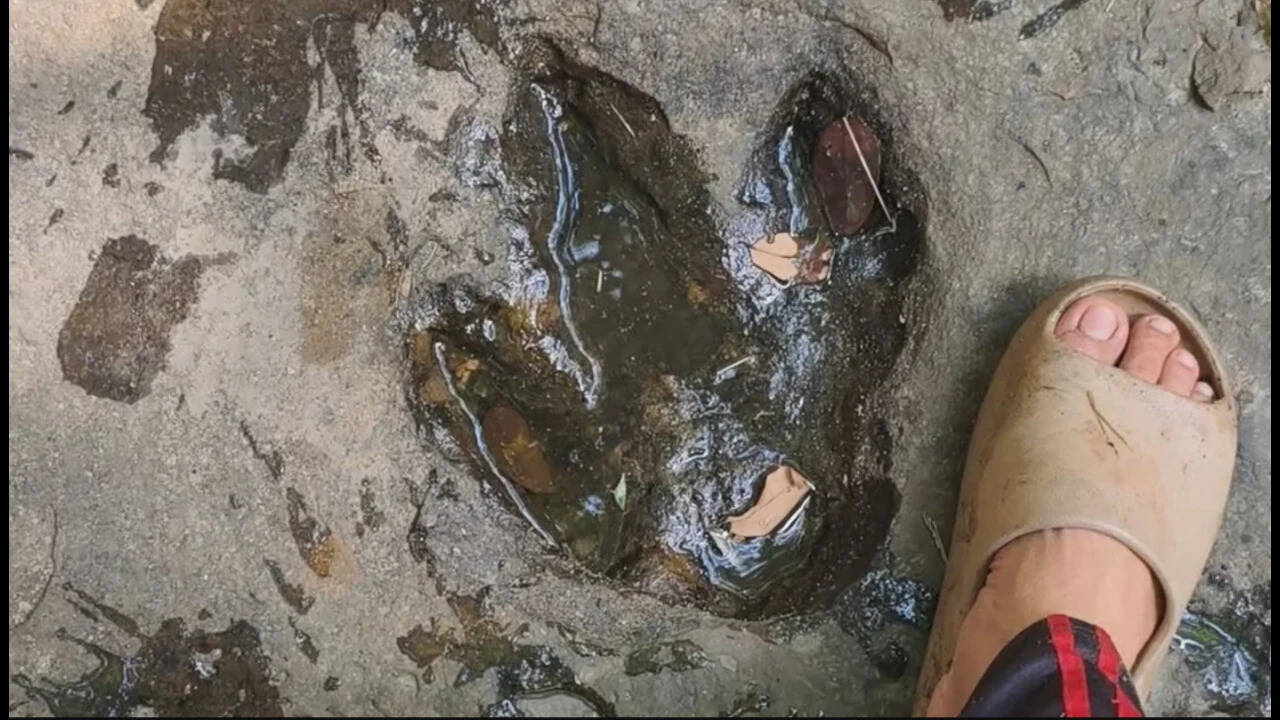
A tourist out for a walk on a nature trail in Thailand noticed something odd stamped into a flat patch of rock.
(1h)3 min read 0 0 0
Creator on ContentVerse. Building, writing, and shipping in public.
Reading this article: 0s
News in 60 words
~150-word AI digest in one read
Thesis, bullets, quote & takeaway — slogan stays "60 words"

Full story
A tourist out for a walk on a nature trail in Thailand noticed something odd stamped into a flat patch of rock. The deep marks looked suspiciously like dinosaur footprints, so he snapped a photo and uploaded it to Facebook to see if anyone in his local group agreed.
He probably wasn't expecting much - maybe a few joke comments or someone telling him it was just erosion. Instead, he ended up triggering a full-scale scientific investigation.
Thailand's Department of Mineral Resources has officially confirmed that those marks are six fossilized dinosaur footprints at Phu Phrabat National Park in Udon Thani province. They’re estimated to be roughly 120 million years old.
The site is now temporarily closed to the public while geologists rush in to examine the area. How a Facebook post led to a prehistoric find It all started when 32-year-old Pichai Prathetsena was hiking along a trail near a creek.
Because the water level was unusually low, a large section of the rocky bed was completely exposed, bringing the strange impressions into plain sight. Pichai took a quick photo and posted it online to ask the community for their thoughts.
He couldn't report it to park rangers right away because his family was rushing to move along, so he just shared the picture and let the internet do its thing. It didn't take long for the post to land on the radar of Thailand’s Department of Mineral Resources.
Officials actually replied directly in his comment section, promising to send a team out to look. By the next day, park rangers were at the stream with measuring tapes.
Just 24 hours later, the department confirmed the verdict: the footprints were the real deal. What began as a casual question on social media had just uncovered a footprint trail buried for millions of years.
What the tracks tell us According to Thailand’s Department of Public Relations, the six footprints form a continuous walking path along the Phu Phan rock layer. They trace back to the Early Cretaceous period—around 120 million years ago.
Each footprint is pretty substantial, measuring roughly 29 centimeters long by 26 centimeters wide. Pressed deep into the sandstone, they’ve managed to survive centuries of water and weather without fading away.
Based on the shape and stride, experts believe the tracks were made by theropods - the group of two-legged, mostly carnivorous dinosaurs that includes iconic hunters like T-rex and raptors. So far, no actual bones or fossilized remains have been spotted nearby.
But trackways like this are often even better than bones for paleontologists. They give scientists a direct snapshot of how these animals actually moved, how fast they walked, and what the local ecosystem felt like when they were stomping through it.
Why the site is on lockdown To keep the site safe, park officials have cordoned off the entire section of the trail. Fossilized footprints are surprisingly fragile; a few heavy rains or too many visitors stepping on the edges could destroy details that took millions of years to preserve.
Local authorities have warned tourists not to dig around the rocks, shift any loose stones, or touch the impressions. Under Thai law, trace fossils like footprints carry the same strict legal protections as dinosaur bones or teeth, making it a serious offense to tamper with them.
For now, the focus is purely on preservation and research. Geologists are mapping out the site to figure out its full scientific value.
If everything goes smoothly, officials hope to eventually turn the spot into an educational park feature where visitors can see the tracks up close without risking damage. It’s not every afternoon that a routine weekend hike turns into a major paleontological discovery.
All it took was a sharp pair of eyes, a smartphone, and a Facebook post to pull a piece of prehistoric history back into the light. Get the latest movie news, reviews, and celebrity updates.
Was this helpful?
Your feedback helps us improve content for everyone.
Liked this piece?
Tip Dhananjay for the work
100% goes to the creator. Send a one-time tip in rupees and back the writing you love.
Dhananjay Singh
3 followers · 514 blogs
Published 22 Oct 2026, 9:00 am IST
Creator on ContentVerse. Building, writing, and shipping in public.
Reviewed by the ContentVerse India editorial team. Educational pages are not personalised advice.
View full profile3 followers
Discussion