
Why AI Is Creating More Jobs Than It Destroys in India: Key Insights & Opportunities
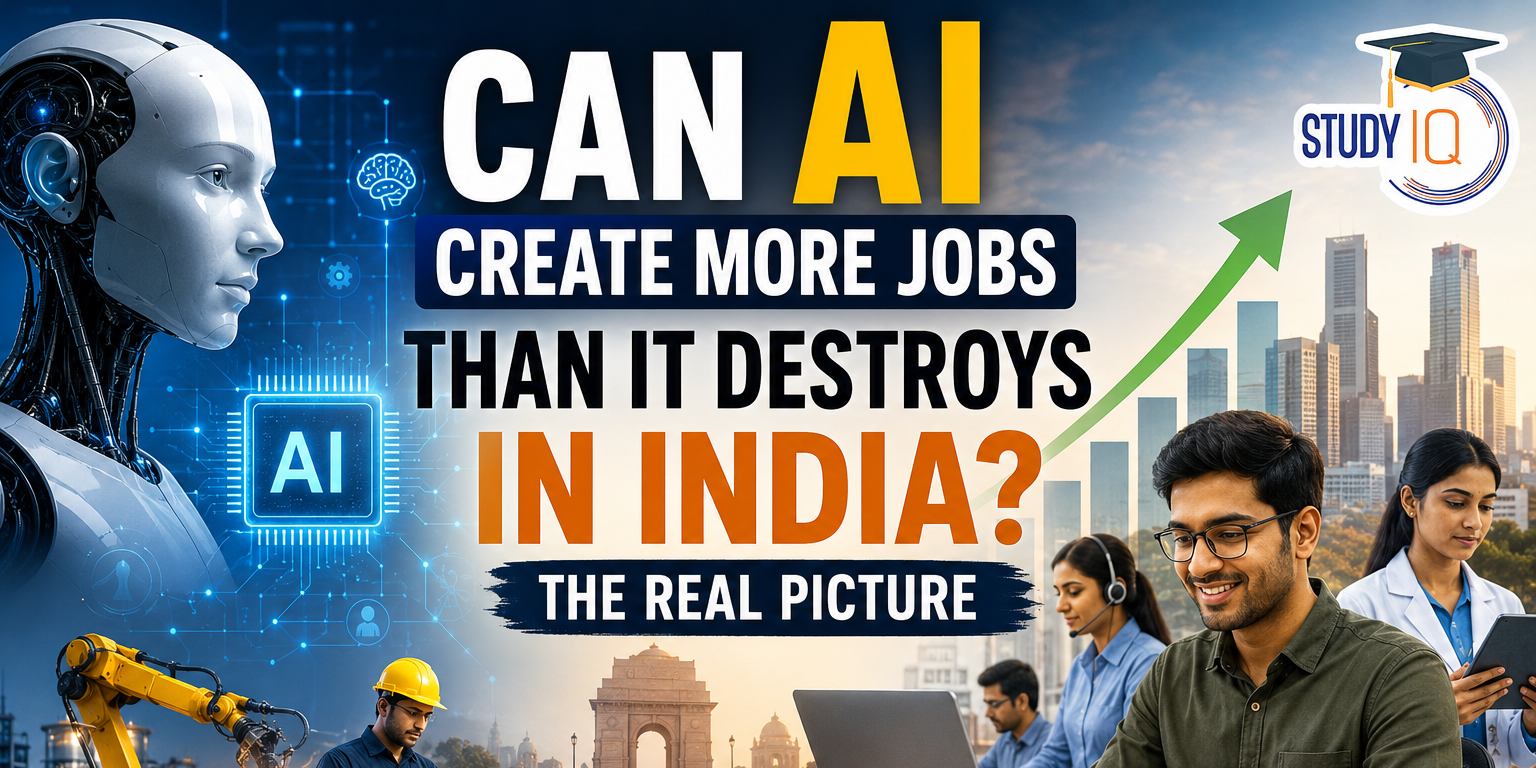
Contrary to fears of widespread automation, artificial intelligence is driving net job creation across India's technology ecosystem. Backed by recent analysis from Nomura and the World Bank, Indian professionals are shifting toward high-value roles and new digital opportunities.
Reading this article: 0s
News in 60 words
~150-word AI digest in one read
Thesis, bullets, quote & takeaway — slogan stays "60 words"
1h ·5 min read· 0 · 0 · 0
Full story
For the past two years, headlines surrounding artificial intelligence have leaned heavily into anxiety. Pundits warned of widespread disruptions across software service exports, customer support hubs, and entry-level operations. Yet, the reality unfolding across India's technology corridors tells a fundamentally different story.
Recent macroeconomic assessments by Nomura and comprehensive labor impact studies from the World Bank reveal that AI is driving net job creation in India rather than mass unemployment. While legacy, repetitive tasks are indeed being automated, the rapid deployment of Generative AI and localized machine learning models is unlocking unprecedented demand for skilled talent. Understanding this structural shift is vital for students, working professionals, and enterprise leaders navigating India's dynamic labor market.
The Macro View: What Nomura and World Bank Data Show
Global economic researchers have begun looking past early speculative fears to analyze real-time hiring data. A recent analysis by Nomura highlights that while AI automation compresses operational timelines in routine IT services, it simultaneously reduces operational costs, enabling Indian enterprises to expand their service portfolios and take on complex, higher-margin global projects.
Similarly, World Bank insights emphasize India's unique demographic position. Rather than replacing human capital, AI tools act as productivity multipliers for Indian tech professionals. By boosting output per worker, Indian firms can offer competitive pricing on sophisticated technological solutions globally, capturing a larger share of global IT spend and generating downstream employment opportunities across hardware, data infrastructure, and specialized services.
From Legacy Code Maintenance to High-Value Engineering
For decades, the foundation of India's tech ecosystem in hubs like Bengaluru, Hyderabad, and Pune relied on legacy application maintenance, manual software testing, and basic infrastructure management. These routine functions are precisely where automation tools excel. However, Indian IT services giants and global capability centers (GCCs) are rapidly reallocating talent toward higher-value engineering.
Instead of managing simple routine ticket resolutions, Indian engineers are now tasked with:
- Building private enterprise LLMs trained on domain-specific datasets
- Designing resilient cloud-native data pipelines for real-time analytics
- Hardening AI models against security vulnerabilities and data leakage
- Integrating computer vision and conversational AI into physical supply chains
This shift moves Indian professionals from backend support roles into core design and innovation, driving higher demand for mid-level and senior talent.
Emerging Roles and Salary Trends in the Indian AI Ecosystem
As organizations shift from AI experimentation to full deployment, entirely new career categories are commanding premium compensation across major tech hubs:
1. AI Integration Engineers and Pipeline Architects
Professionals capable of connecting enterprise databases with commercial and open-source models are in high demand. Mid-level developers transitioning into these roles routinely see starting offers ranging from ₹14 LPA to ₹28 LPA in cities like Gurugram and Bengaluru.
2. Data Annotation, Localization, and Language Curators
With initiatives like the Government of India's Bhashini project aiming to bridge linguistic divides, there is a surge in demand for regional language specialists. Curating datasets for Indic languages (such as Hindi, Tamil, Bengali, and Marathi) has created thousands of entry-level and gig-economy jobs across Tier-2 and Tier-3 cities like Kochi, Jaipur, and Lucknow.
3. AI Governance, Ethics, and Compliance Officers
Following the enforcement of India's Digital Personal Data Protection (DPDP) Act 2023, organizations require experts to audit algorithms for bias, privacy, and regulatory adherence. These multidisciplinary roles bridge legal policy and software engineering, yielding salaries between ₹18 LPA and ₹35 LPA for experienced professionals.
Sectoral Transformation Beyond Metropolitan Tech Hubs
The impact of AI-driven job creation extends far beyond traditional technology corridors. Non-tech industries across India are embedding intelligent systems into their daily operations, triggering localized hiring sprees:
- Healthcare: Diagnostic centers in Tier-2 cities are hiring medical technicians trained to operate AI-assisted radiology and pathology software, accelerating patient triage.
- Agri-Tech: Startups in states like Maharashtra and Telangana employ field operatives to deploy computer-vision tools for crop health assessment and soil analysis.
- Fintech & Micro-Lending: Non-banking financial companies (NBFCs) use AI credit scoring models to reach unbanked populations, requiring local operations teams to verify data and manage customer relationships.
Practical Steps to Capitalize on the AI Job Boom
To position yourself advantageously in this evolving hiring market, adopt a structured, proactive strategy:
- Leverage National Upskilling Platforms: Explore government-backed resources like FutureSkills Prime, a joint initiative by MeitY and NASSCOM, which offers subsidized certification courses in AI, Big Data, and Cloud Computing.
- Shift Focus to Domain Expertise: Combine technical foundational knowledge with deep industry context. An engineer who understands both Python and retail supply chain management is far less replaceable than one who only writes generic scripts.
- Master Workflow Orchestration: Learn to use AI tools (such as GitHub Copilot, ChatGPT Enterprise, or Claude) to accelerate your current output. Employers increasingly favor candidates who can demonstrate a 3x-5x productivity gain using modern toolkits.
Frequently Asked Questions (FAQs)
Will entry-level IT jobs completely disappear in India due to AI?
No, but entry-level roles are being redefined. Basic manual testing and repetitive coding tasks are declining, but entry-level positions focused on data validation, AI model maintenance, prompt engineering, and functional debugging are growing rapidly.
Do I need a degree in Data Science to pivot into an AI career?
Not necessarily. Many professionals with backgrounds in business analysis, product management, domain operations, or core software development successfully transition by taking focused certifications and demonstrating practical hands-on project portfolios.
How does the DPDP Act 2023 affect AI job opportunities in India?
The DPDP Act obligates companies to handle user data ethically and transparently. This regulation has spurred fresh demand for data privacy auditors, cybersecurity specialists, and AI compliance analysts across Indian enterprises.
Actionable Conclusion
The narrative that artificial intelligence will trigger structural economic decline in India overlooks the historical adaptability of the country's technology workforce. As research from Nomura and the World Bank highlights, AI is acting as a catalyst for new industries, elevated productivity, and localized economic growth. By committing to continuous learning, acquiring domain-specific skills, and embracing AI assistance in daily workflows, Indian professionals can secure long-term success in an increasingly automated world.
Support creators
If you found this analytical guide insightful, consider tipping the writer on ContentVerse India to support independent tech and economic journalism.
Was this helpful?
Your feedback helps us improve content for everyone.
Liked this piece?
Tip Dhananjay for the work
100% goes to the creator. Send a one-time tip in rupees and back the writing you love.
Dhananjay Chauhan
0 followers · 0 blogs
Creator on ContentVerse. Building, writing, and shipping in public.
0 followers



Discussion