
Doon study flags health risks from kitchen emissions, excavation dust
DEHRADUN: Frequent digging of roads across Dehradun for utility works, including the laying of sewer lines, water pipelines and piped natural gas lines, is addi
(1h)3 min read 1 0 0
Creator on ContentVerse. Building, writing, and shipping in public.
Reading this article: 0s
News in 60 words
~150-word AI digest in one read
Thesis, bullets, quote & takeaway — slogan stays "60 words"

Full story
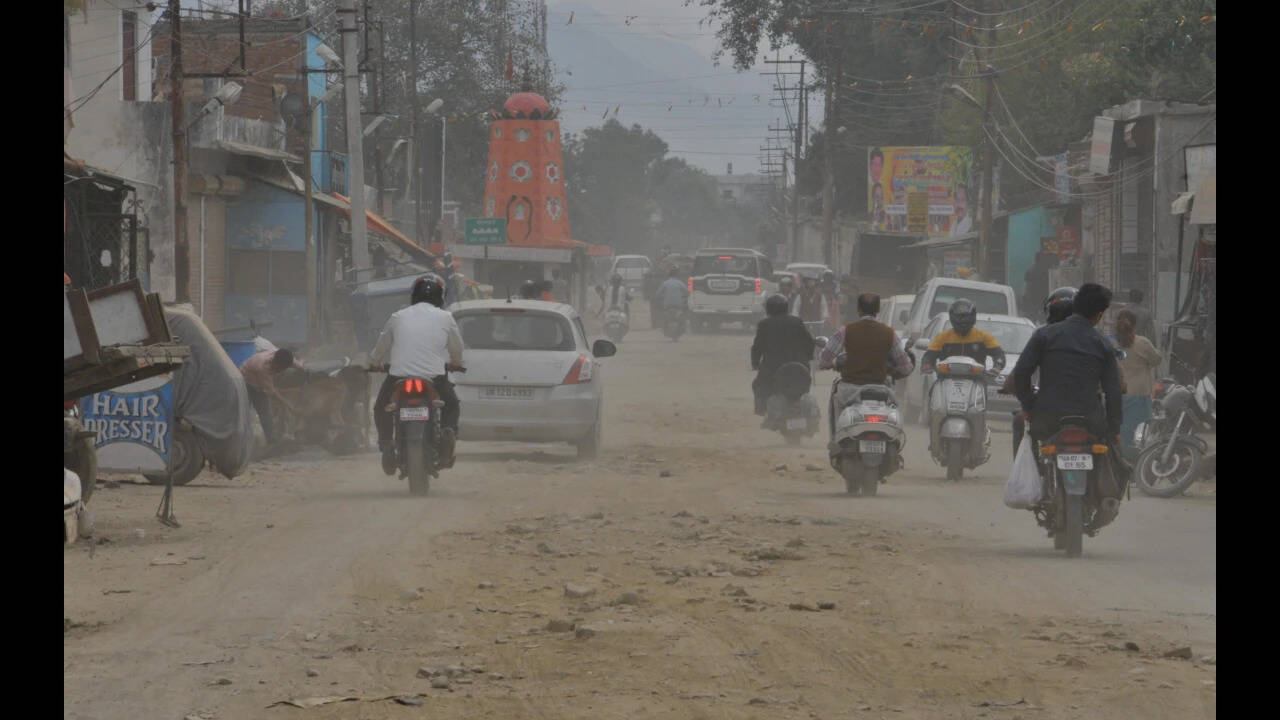
DEHRADUN: Frequent digging of roads across Dehradun for utility works, including the laying of sewer lines, water pipelines and piped natural gas lines, is adding to the city’s particulate pollution burden, with a Doon University study flagging health risks from excavation dust and restaurant kitchen emissions. Published earlier this year in the journal Environmental Monitoring and Assessment, the study, titled ‘Evaluation of particulate matter from kitchen eateries and road dust: oxidative potential and health impacts in the Himalayan foothill city, Dehradun’, recorded an average PM2.5 concentration of 301.16 micrograms per cubic metre in restaurant kitchens, while PM10 levels at road excavation sites averaged 201.16 micrograms per cubic metre.
The researchers examined the particles’ chemical composition, their potential to cause cellular damage and the extent to which they could settle in different parts of the respiratory system. The study found that fine particles (PM2.5) can travel deep into the lungs, while larger particles (PM10) tend to settle in the nose, throat and upper airways.
Its modelling also found that older people had the highest estimated particle deposition in the respiratory tract, while infants had the lowest. However, lower estimated deposition does not necessarily mean lower health risk, as the impact can also depend on particle composition, toxicity, exposure duration and a person’s vulnerability, the study pointed out.
The researchers appealed for better ventilation and vented cooking stoves in eateries, along with effective dust-control measures at excavation sites. Researcher Vijay Shridhar said dust-control measures were lacking at excavation sites and residents should not have to bear the pollution caused by development work in densely populated areas.
He added that particles released by burning biomass, wood and coal in eateries could have greater oxidative potential than mineral-rich road dust, even when their concentrations were lower. “There is a need for coordination among govt agencies to prevent repeated digging of the same roads for various utility services,” he said.
Shridhar clarified that sampling was conducted over two hours to analyse the particles’ chemical composition and oxidative potential and was not intended to measure 24-hour air quality. “The purpose was not to measure 24-hour emissions.
Even one or two hours of exposure to such pollution can affect people living in populated areas,” he said. The concerns over excavation dust come amid frequent road digging across the city for utility works.
During an inspection of Chakrata Road last week, district magistrate Ashish Chauhan flagged excavation without permission and directed officials to issue a notice to the Asian Development Bank (ADB) authorities concerned. He warned that road digging must be carried out only after obtaining the required permissions.
Meanwhile, PWD secretary Pankaj Pandey said a new road-cutting policy had been prepared and was awaiting state govt approval. The policy is aimed at regulating road excavation and improving coordination among agencies undertaking utility works.
Stay updated with the latest Dehradun news.
Key quotes
-
“There is a need for coordination among govt agencies to prevent repeated digging of the same roads for various utility services,”
-
“The purpose was not to measure 24-hour emissions. Even one or two hours of exposure to such pollution can affect people living in populated areas,”
Was this helpful?
Your feedback helps us improve content for everyone.
Liked this piece?
Tip Dhananjay for the work
100% goes to the creator. Send a one-time tip in rupees and back the writing you love.
Dhananjay Singh
3 followers · 306 blogs
Published 21 Oct 2026, 1:00 pm IST · Updated 21 Oct 2026, 1:29 pm IST
Creator on ContentVerse. Building, writing, and shipping in public.
Reviewed by the ContentVerse India editorial team. Educational pages are not personalised advice.
View full profile3 followers
Discussion