
How to Build a High-Paying Career in AI Engineering in India: A Complete Roadmap
The rapid expansion of artificial intelligence has created unprecedented demand for specialized developers across India's top tech hubs. This comprehensive roadmap outlines the technical skills, portfolio projects, and strategic positioning needed to land high-paying AI engineering roles in India.
Reading this article: 0s
News in 60 words
~150-word AI digest in one read
Thesis, bullets, quote & takeaway — slogan stays "60 words"
1h ·6 min read· 0 · 0 · 0
Full story
The Unprecedented Surge in Indian AI Talent Demand
Driven by recent headlines of massive compensation packages offered by global capability centers (GCCs) and fast-growing Indian tech unicorns, software developers across India are shifting focus toward Artificial Intelligence engineering. Tech hubs like Bengaluru, Hyderabad, Gurugram, and Pune are witnessing an unprecedented surge in hiring for specialized AI roles. Companies are actively seeking developers who can move beyond basic scripting and build production-ready AI applications.
Traditional software roles are evolving rapidly, with market demands favoring engineers capable of integrating Large Language Models (LLMs), optimizing vector search systems, and maintaining robust MLOps pipelines. Mid-level AI engineers in India now command compensation packages ranging from ₹18 Lakhs to ₹35 Lakhs per annum (LPA), while senior leads and principal engineers at top tier firms frequently surpass ₹50 Lakhs to ₹80 Lakhs LPA.
To tap into these high-paying opportunities, you need a targeted strategy. This guide breaks down the precise technical stack, portfolio projects, and interview preparation tactics required to stand out in the competitive Indian job market.
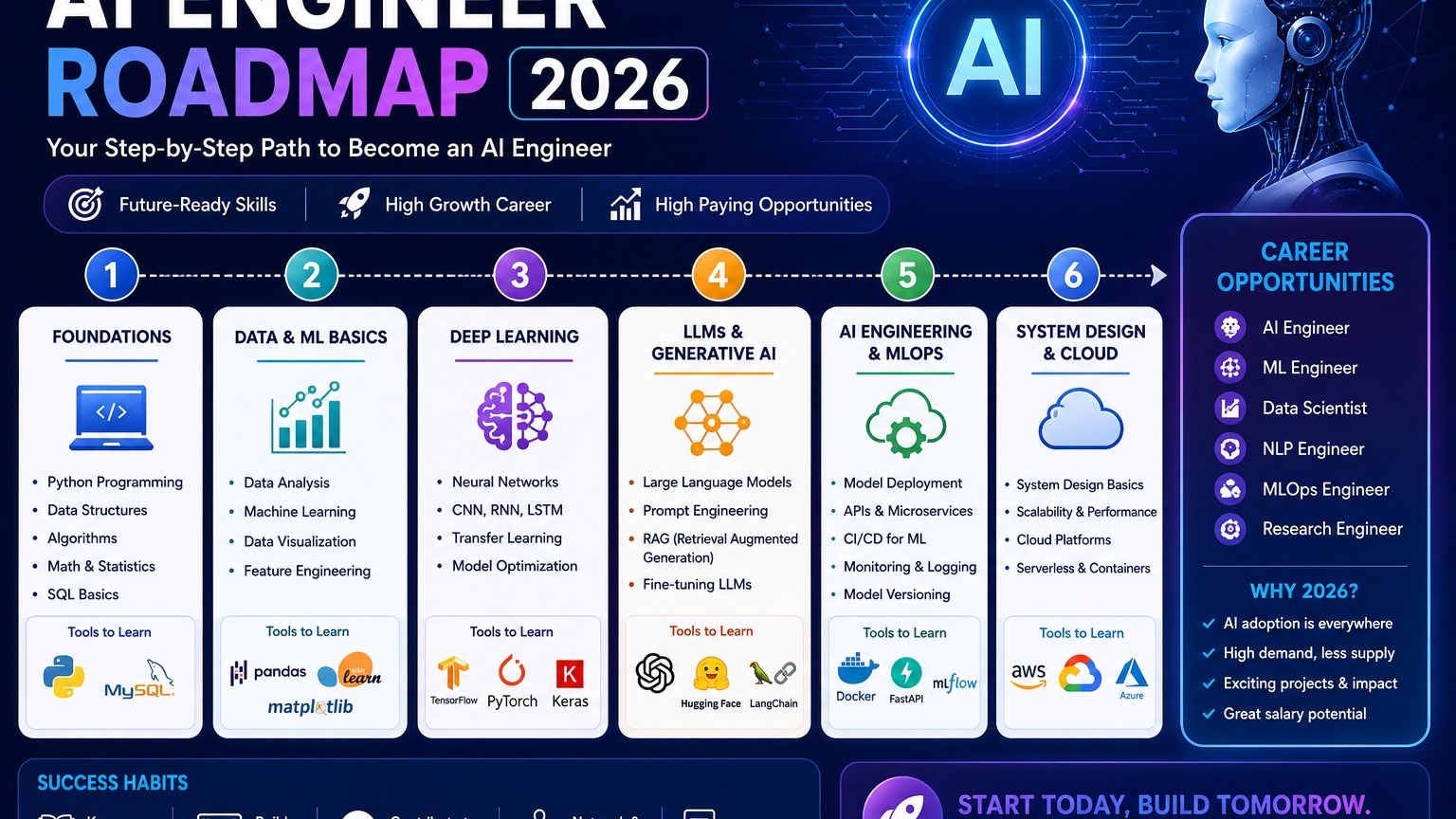
1. Core Technical Foundations for AI Engineers
Unlike traditional Data Scientists who focus primarily on statistical analysis and research models, an AI Engineer's primary role is building, deploying, and scaling software powered by machine learning algorithms. Mastering the foundational stack is non-negotiable.
Core Programming and Math Essentials
- Python Proficiency: Deep understanding of object-oriented programming, asynchronous execution, and data handling libraries like Pandas and NumPy.
- Applied Mathematics: Functional knowledge of linear algebra, probability, calculus, and matrix multiplication needed to understand optimization algorithms.
- Database Mechanics: Strong expertise in traditional SQL systems (PostgreSQL, MySQL) alongside modern NoSQL frameworks.
Machine Learning & Deep Learning Frameworks
- PyTorch & TensorFlow: Mastery over PyTorch is currently the industry standard for production model manipulation and fine-tuning.
- Scikit-Learn: Crucial for baseline predictive modeling and classic machine learning algorithms like XGBoost and Random Forests.
2. The Generative AI & Modern Stack
The technological pivot toward Generative AI has redefined what companies expect from an engineering applicant. Building apps using raw API calls is no longer enough; employers look for candidates who understand complex retrieval and orchestrations.
LLM Orchestration Frameworks
To create enterprise-grade intelligent agents, you must master orchestration tools like LangChain and LlamaIndex. These frameworks enable you to build multi-step pipelines that integrate external databases, APIs, and reasoning loops directly into your application architecture.
Vector Databases and Information Retrieval
Retrieval-Augmented Generation (RAG) is the backbone of internal enterprise tools today. You should gain hands-on experience with dedicated vector databases such as:
- Pinecone and Qdrant for hosted, cloud-native vector search.
- ChromaDB and Milvus for open-source, self-hosted search implementations.
- PGVector for extending existing PostgreSQL relational databases with similarity matching.
Fine-Tuning and Open-Source Models
Understanding how to host and fine-tune open-weight models like Meta's Llama 3 or Mistral using techniques like LoRA (Low-Rank Adaptation) and QLoRA is a high-value skill. Acquaint yourself with tools like Hugging Face Transformers, TRL, and local inference runtimes like Ollama and vLLM.
3. MLOps: Transitioning Models to Production
A common reason software developers fail AI technical interviews in India is a lack of operational knowledge. Designing a model inside a Jupyter Notebook is simple, but serving it securely to millions of users requires operational expertise.
Key MLOps Capabilities to Develop
- Containerization & Deployment: Packaging models into lightweight Docker containers and orchestrating them with Kubernetes.
- API Development: Creating fast REST and gRPC endpoints using FastAPI or Go to interface models with frontend applications.
- Model Monitoring & Observability: Implementing tools like MLflow, Weights & Biases, or LangSmith to track latency, token usage, drift, and hallucination metrics.
- Cloud Platforms: Hands-on familiarity with cloud ecosystem AI suites like AWS SageMaker, Google Cloud Vertex AI, or Azure Machine Learning.
4. Building a Standout Portfolio for the Indian Job Market
When applying to top tech firms in Bengaluru or Gurugram, basic projects like predicting house prices or sentiment analysis on generic datasets will not get you noticed. Your portfolio should showcase solutions to complex, localized, or real-world enterprise problems.
High-Impact Project Ideas
- Vernacular Voice AI Assistant: Build an interactive voice application using Whisper and localized speech models (like Sarvam AI or Bhashini APIs) catering to regional Indian languages.
- Enterprise Legal/GST RAG System: Construct a high-accuracy RAG pipeline indexed on complex Indian tax codes or legal documents featuring hybrid search and reranking.
- Autonomous Customer Support Agent: Develop a multi-agent system using LangGraph that automates complex multi-step e-commerce workflows like order tracking, returns, and refunds.
Host your code publicly on GitHub with detailed README.md documentation, architecture diagrams, and live hosted demos on platforms like Hugging Face Spaces or Vercel.
5. Strategic Job Hunting: Target Companies and Salaries
Navigating the employment landscape strategically increases your compensation potential significantly. The Indian hiring market for AI developers is split across three main categories:
- Global Capability Centers (GCCs): Companies like Target, Walmart, and J.P. Morgan in Bengaluru and Hyderabad offer high stability, competitive salaries (₹20L - ₹45L PA), and massive dataset exposure.
- Product Unicorns & Mid-Stage Startups: Companies like Swiggy, Razorpay, Zomato, and Zepto look for engineers who can move fast and scale systems, offering lucrative ESOP packages alongside base salaries.
- Pure-Play AI Startups: Companies like Sarvam AI, Krutrim, and niche AI consultancies offer immense learning velocity and direct exposure to cutting-edge model development.
Networking actively on LinkedIn, presenting at local tech meetups, and contributing to open-source repositories like LangChain or vLLM often open backchannel interview referrals that yield the highest compensation offers.
Frequently Asked Questions
Can a non-IIT/NIT graduate secure a ₹30+ LPA AI engineering job in India?
Yes. While top college tags can help land initial campus interviews, the AI domain heavily prioritizes practical execution, open-source contributions, and system design expertise over institutional pedigree.
What is the main difference between a Data Scientist and an AI Engineer?
Data Scientists focus on statistics, experimentation, data visualization, and training predictive models. AI Engineers focus on software development, integration, MLOps, vector search, and building production infrastructure around AI models.
Is a Master’s degree or PhD mandatory for AI engineering roles?
No. A research-heavy background is typically required for AI Research Scientist roles, but a Bachelor's degree in Computer Science or a related engineering discipline is entirely sufficient for high-paying AI Engineering positions.
Actionable Next Steps
To launch your AI engineering career, focus on building one production-grade project end-to-end. Document your learning journey publicly, contribute to open-source toolkits, and systematically upgrade your operational skills in API design, vector databases, and model deployment.
Support creators
If you found this career guide helpful, consider tipping the author on ContentVerse India to support more high-quality developer resources.
Was this helpful?
Your feedback helps us improve content for everyone.
Liked this piece?
Tip Dhananjay for the work
100% goes to the creator. Send a one-time tip in rupees and back the writing you love.
Dhananjay Singh
0 followers · 0 blogs
Creator on ContentVerse. Building, writing, and shipping in public.
0 followers


Discussion