
Is AI Stealing Indian Tech Jobs? What Nomura's Hiring Data Shows
A landmark report by Nomura reveals that artificial intelligence is currently creating more jobs in India than it eliminates. Learn where the hiring boom is taking place and how tech professionals can adapt to stay ahead.
Reading this article: 0s
News in 60 words
~150-word AI digest in one read
Thesis, bullets, quote & takeaway — slogan stays "60 words"
1h ·6 min read· 0 · 0 · 0
Full story
For the past eighteen months, a shadow of uncertainty has hung over India’s USD 250-billion technology sector. From Bengaluru’s Outer Ring Road to Hyderabad’s HITEC City, mid-career software engineers and fresh engineering graduates alike have voiced the same underlying anxiety: Is generative AI going to make Indian software engineers obsolete?
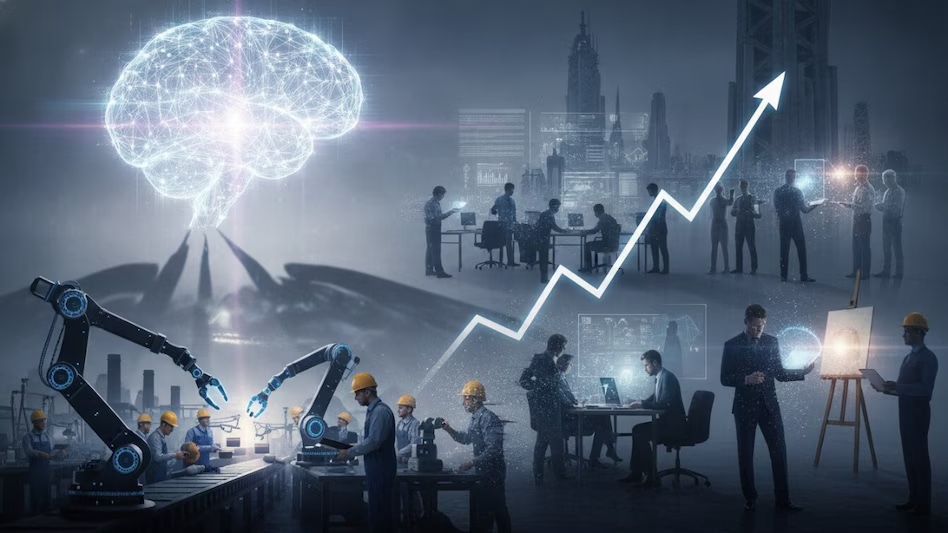
However, hard data from a new global study offers a refreshing and reassuring perspective. A comprehensive report by Japanese financial service giant Nomura reveals that AI is currently generating more net employment opportunities in India than it is eliminating. Rather than triggering mass workforce destruction, artificial intelligence is reshaping the Indian technology landscape, driving an unexpected wave of high-value hiring across major metropolitan hubs.
Decoding Nomura's Findings: A Net-Positive Shift
Nomura's detailed analysis of recruitment pipelines and enterprise hiring trends indicates that while routine coding and manual support roles are contracting, demand for specialized technology talent is expanding at a faster pace. The net result is positive for the Indian job market.
Historically, Indian IT built its empire on scale—deploying large teams for legacy system maintenance, manual software testing, and infrastructure management. Generative AI tools like GitHub Copilot and ChatGPT have automated significant portions of these entry-level tasks. However, this productivity efficiency has freed up enterprise capital, which is now being funneled directly into building bespoke AI architectures, data engineering pipelines, and cybersecurity frameworks.
According to the report, India’s unique advantage lies in its vast pool of adaptable technical talent and its rapid absorption of Global Capability Centres (GCCs). Foreign enterprises are not pulling out of India; instead, they are shifting higher-value AI research and development centers directly to Indian soil.
Where the New Jobs Are: Emerging AI Roles and Salary Trends
While traditional software maintenance jobs are seeing slower growth, specialized technology profiles are experiencing aggressive hiring competition. Companies across Bengaluru, Hyderabad, Pune, and the National Capital Region (NCR) are actively recruiting for specific technical roles.
High-Demand AI Roles in India
- Data Pipeline and Infrastructure Engineers: Organizations need clean, structured data before implementing AI models. Engineers who can manage cloud data warehouses on AWS, Azure, or Snowflake are seeing immense demand.
- Enterprise AI Implementers and Orchestrators: Developers skilled in frameworks like LangChain, LlamaIndex, and vector databases (such as Pinecone or Milvus) are being recruited to build custom enterprise tools.
- AI Ethics, Security, and Compliance Specialists: As regulatory scrutiny grows around algorithmic bias and data privacy under India's Digital Personal Data Protection (DPDP) Act, legal-tech and compliance roles are expanding rapidly.
- Prompt Engineers and Fine-Tuners: Domain experts who understand how to fine-tune open-source models (like Llama 3 or Mistral) for specific industry domains like healthcare, banking, and logistics.
Compensation Realities
Salary offerings reflect this demand shift. While entry-level generic developer packages remain stagnant around ₹4.5 LPA to ₹6 LPA at legacy IT majors, professionals who pivot to specialized AI and data roles are commanding significant premiums. A mid-level developer (3–6 years of experience) transitioning into enterprise AI integration can reasonably expect compensation packages ranging between ₹16 LPA and ₹28 LPA in Indian tech hubs.
The Real Casualty: Repetitive Tasks, Not Tech Careers
The Nomura report highlights a critical distinction: AI is displacing tasks, not whole professions. The roles experiencing the sharpest decline are those reliant on predictable, repetitive processes.
- Manual Quality Assurance (QA) & Testing: Automation tools can now generate test scripts in seconds, significantly shrinking dedicated manual QA teams.
- Basic L1/L2 Helpdesk Support: AI-powered conversational bots are handling routine tier-one customer service and IT support tickets.
- Basic Code Translation: Legacy migration tasks—such as converting COBOL to Java—are now largely handled by automated LLM tools with minimal human supervision.
Engineers who spent their days writing boilerplate code are feeling the pressure. Conversely, tech professionals who focus on architecture design, system integration, complex problem solving, and product vision are finding themselves more valuable than ever.
Global Capability Centres (GCCs) Fueling the Upsurge
One of the main engines behind this hiring boom is the explosive growth of Global Capability Centres across Tier-1 Indian cities. Over 1,600 GCCs currently operate in India, contributing over ₹3.5 lakh crore to the economy.
Global financial institutions, retail giants, and pharmaceutical conglomerates are no longer viewing their Indian hubs as mere cost-cutting back offices. They are transforming their Indian operations into global innovation centers. Because AI models require continuous refinement, domain domain expertise, and robust data hygiene, international corporations are building out full-stack AI teams directly in cities like Chennai, Hyderabad, and Gurugram.
Practical Playbook: How Indian Tech Workers Can Capitalize
If you are a software professional in India looking to future-proof your career, relying solely on your existing skill set is no longer sufficient. Here is a practical, actionable plan to stay ahead:
- Master the Foundation First: Do not skip core data engineering skills. Before jumping into deep learning, ensure you have strong command over Python, SQL, advanced data structures, and cloud computing principles.
- Leverage Government and Industry Initiatives: Platforms like NASSCOM's FutureSkills Prime (backed by the Ministry of Electronics and IT) offer subsidized, certified courses in generative AI, cloud computing, and big data.
- Build Open-Source Proof-of-Work: Recruiters today prioritize tangible evidence over resume buzzwords. Build working AI applications, contribute to open-source GitHub repositories, and document your deployment processes publicly on LinkedIn.
- Adopt AI Tools Immediately: Integrate coding assistants like GitHub Copilot, Cursor, or Claude into your daily coding workflow. Demonstrating that you can code 3x faster using AI makes you an immediate asset to any engineering team.
Frequently Asked Questions (FAQs)
Will fresh engineering graduates still get hired in India?
Yes, but the hiring standards have evolved. Top IT services companies and product firms are looking for freshers who possess hands-on familiarity with cloud environments, basic machine learning libraries, and practical project portfolios, rather than purely theoretical textbook knowledge.
Do I need a Ph.D. in Mathematics to work in AI?
No. While research scientists at major labs require deep academic backgrounds, the vast majority of open jobs in India are for AI application developers and data engineers who know how to integrate, fine-tune, and deploy existing tools for enterprise use cases.
Which programming languages should I prioritize for AI roles?
Python remains the undisputed leader in the AI ecosystem due to its rich library framework (PyTorch, TensorFlow, Pandas). JavaScript/TypeScript is also vital for building front-end interfaces for AI applications, alongside SQL for backend data management.
Conclusion
The narrative that AI is a ruthless job killer in India is overly simplistic and unsupported by hiring statistics. As Nomura's research demonstrates, AI is acting as a catalyst for a massive structural upgrade within the Indian IT industry. While routine, manual roles are indisputably declining, higher-value opportunities are emerging at an unprecedented rate. By proactively upskilling and embracing AI tools rather than fearing them, Indian tech professionals can comfortably navigate this technology transition and thrive in the modern global economy.
Support creators
If you found this analysis helpful, consider tipping the author on ContentVerse India to support independent, high-quality tech journalism.
Was this helpful?
Your feedback helps us improve content for everyone.
Liked this piece?
Tip Dhananjay for the work
100% goes to the creator. Send a one-time tip in rupees and back the writing you love.
Dhananjay Chauhan
0 followers · 0 blogs
Creator on ContentVerse. Building, writing, and shipping in public.
0 followers


Discussion