
Startup India Fund of Funds 2.0: How Founders Can Access the ₹10,000 Cr Corpus
The Department for Promotion of Industry and Internal Trade has refreshed guidelines for the ₹10,000 Crore Fund of Funds for Startups. Learn how early-stage Indian founders can leverage SIDBI-backed VCs to position their ventures for growth capital.
Reading this article: 0s
News in 60 words
~150-word AI digest in one read
Thesis, bullets, quote & takeaway — slogan stays "60 words"
3h ·6 min read· 0 · 0 · 0

Full story
Disclaimer: This is educational content, not financial advice.
India's startup ecosystem is entering a mature phase. While domestic venture capital activity saw cautious recalibration through 2023 and early 2024, institutional support from the Government of India has received a significant upgrade. The Department for Promotion of Industry and Internal Trade (DPIIT) recently released updated operational guidelines for the ₹10,000 Crore Fund of Funds for Startups (FFS 2.0).
Managed primarily through the Small Industries Development Bank of India (SIDBI), FFS 2.0 isn't just a continuation of past policies—it represents a structural shift toward patient capital, deep-tech prioritization, and regional decentralization beyond metro hubs like Bengaluru, Gurugram, and Mumbai. For founders looking to raise Seed to Series A capital, understanding how FFS 2.0 functions is vital to securing institutional backing.
What is the Startup India Fund of Funds 2.0?
Unlike traditional government schemes that offer direct cash grants, the Fund of Funds operates as an indirect capital catalyst. DPIIT does not invest directly into your startup’s bank account. Instead, DPIIT allocates capital to SIDBI, which acts as an anchor investor in SEBI-registered Alternative Investment Funds (AIFs)—commonly known as venture capital funds.
Under FFS 2.0, SIDBI commits up to 20–35% of a participating VC fund's total target corpus. The private VC fund must then raise the remaining 65–80% from private limited partners (LPs) and deploy the combined capital into eligible Indian startups.
Key Changes in FFS 2.0
- Higher Anchor Commitment: Increased capital backing for early-stage Category I and Category II AIFs.
- Mandatory Regional Allocation: Incentives for venture funds that direct capital toward Tier-2 and Tier-3 cities like Jaipur, Kochi, Ahmedabad, and Indore.
- Deep Tech & Manufacturing Focus: Strategic pushes toward hardware, semiconductor, defense, and agritech ventures requiring longer gestation periods.
Understanding Eligibility: Does Your Startup Qualify?
To benefit from the ₹10,000 Cr corpus, your enterprise must fulfill basic criteria set by DPIIT as well as the mandate of the participating SIDBI-backed VC fund.
Core DPIIT Requirements
- DPIIT Recognition: Your entity must be formally recognized as a startup by DPIIT on the Startup India portal. You must hold a valid Recognition Number.
- Entity Type: The business must be incorporated as a Private Limited Company, a Registered Partnership Firm, or a Limited Liability Partnership (LLP) in India.
- Age of Firm: The company should be within 10 years from its date of incorporation.
- Turnover Cap: Annual turnover must not have exceeded ₹100 Crore in any of the financial years since incorporation.
- Original Entity: The venture must not be formed by splitting up or reconstructing an existing business.
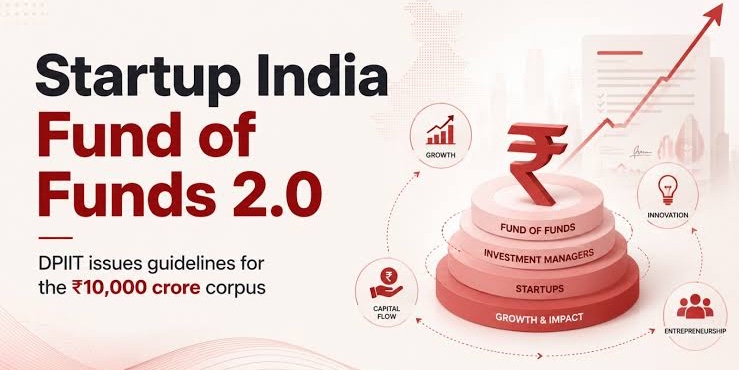
How Capital Flows: From Government to Startup
Many founders waste months submitting pitch decks directly to government departments. It is crucial to understand the structural hierarchy of how FFS 2.0 capital actually moves:
- DPIIT & Ministry of Commerce: Allocates the sovereign budget to the Fund of Funds corpus.
- SIDBI (Operating Agency): Evaluates VC fund managers and allocates anchor capital to eligible Category I and II AIFs.
- Venture Capital Funds (AIFs): Raise matching private funds, perform due diligence, and select high-potential startups.
- Startup Founders: Pitch directly to these participating VCs, complete diligence, and receive investment in exchange for equity.
When pitching to a domestic VC, asking if they have received a SIDBI FFS commitment is a smart way to gauge their dry powder and regulatory alignment.
Step-by-Step Blueprint to Access FFS 2.0 Capital
If you are an early-stage founder preparing for a funding round, follow this operational checklist to target FFS-backed capital:
Step 1: Secure DPIIT Recognition
Ensure your registration on the Startup India Portal (startupindia.gov.in) is active. Keep your certificate of recognition handy, as SEBI-registered AIFs must submit this documentation to SIDBI during capital drawdowns.
Step 2: Identify SIDBI-Backed AIFs
SIDBI periodically publishes lists of approved AIFs on its official portal and annual reports. Look for funds operating as Category I (Venture Capital Funds, SME Funds) and Category II AIFs. Prominent VC firms like Blume Ventures, India Quotient, and Unicorn India Ventures have historically drawn allocations from SIDBI-managed funds.
Step 3: Align Pitch Materials with FFS Priorities
Highlight elements in your deck that align with DPIIT's strategic goals:
- Job Creation: Concrete metrics on direct and indirect employment in India.
- IP Creation: Patents filed, proprietary technology developed, or deep-tech innovation.
- Geographic Footprint: Operations, supply chains, or talent hubs located outside Tier-1 cities.
Step 4: Ensure Corporate Governance Readiness
SIDBI-backed funds face strict audit standards. Ensure your cap table is clean, intellectual property is assigned to the Indian operating entity, statutory filings (GST, Income Tax, MCA returns) are up to date, and audited financials are available.
Common Myths About Fund of Funds 2.0
- Myth 1: FFS funding is a debt or grant. Fact: FFS capital reaches startups strictly as equity investments through private venture capital funds. Startups do not owe repayment; they sell equity.
- Myth 2: Foreign-incorporated startups can access FFS 2.0. Fact: FFS rules mandate investment in Indian entities. Flip-structured startups domiciled in Singapore or Delaware generally must have an active, operating Indian subsidiary where value and IP reside to remain eligible.
- Myth 3: You can apply directly on the DPIIT website for funds. Fact: DPIIT does not review individual startup pitch decks. You must approach the VC funds that received allocations from SIDBI.
FAQs
Can startups apply directly to SIDBI for FFS 2.0 capital?
No. SIDBI does not directly invest equity into individual commercial startups under the FFS scheme. Startup founders must pitch directly to SEBI-registered Alternative Investment Funds (AIFs) that have received capital commitments from SIDBI.
Is DPIIT recognition mandatory to receive funds under FFS 2.0?
Yes. To qualify for capital deployed under the FFS 2.0 mandate, the startup must hold an active DPIIT recognition certificate at the time of equity investment.
What check sizes can founders expect from FFS-backed VCs?
Check sizes vary depending on the partner VC fund's thesis. Early-stage Seed rounds typically range between ₹50 Lakhs to ₹3 Crores, while Series A investments can range from ₹10 Crores to ₹35 Crores.
Actionable Takeaway for Indian Entrepreneurs
The FFS 2.0 initiative underlines a growing institutional push to build sustainable, domestic-capital-backed companies in India. Rather than waiting for foreign capital markets to thaw, founders should actively map and engage domestic VC funds that leverage SIDBI's corpus. Ensure your DPIIT paperwork is current, clean up your corporate compliance, and highlight your long-term domestic value creation when presenting your pitch.
Support creators
If you found this guide helpful, consider supporting independent business writers on ContentVerse India by tipping.
Was this helpful?
Your feedback helps us improve content for everyone.
Liked this piece?
Tip Dhananjay for the work
100% goes to the creator. Send a one-time tip in rupees and back the writing you love.
Dhananjay Singh
0 followers · 0 blogs
Creator on ContentVerse. Building, writing, and shipping in public.
0 followers


Discussion