
AI in Indian Classrooms: How Artificial Intelligence is Transforming Teaching
Discover how artificial intelligence is reshaping Indian education, from CBSE tech initiatives to personalized learning apps used by students across metros and tier-2 cities.
Reading this article: 0s
News in 60 words
~150-word AI digest in one read
Thesis, bullets, quote & takeaway — slogan stays "60 words"
2h ·5 min read· 0 · 0 · 0
Full story
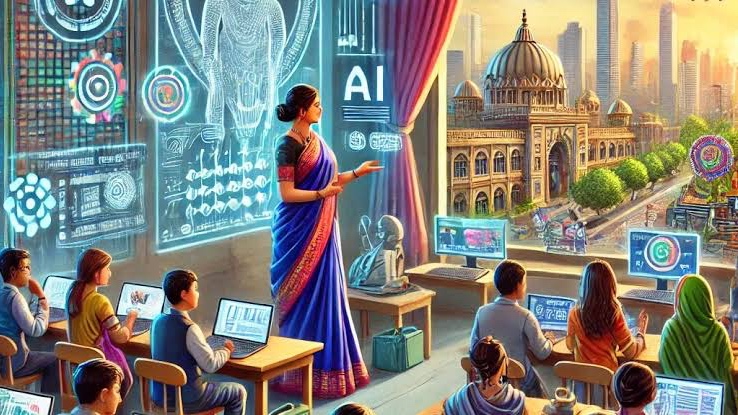
Indian education stands at a fascinating crossroads. From high-tech international schools in Bengaluru to government-run smart classrooms in rural Maharashtra, artificial intelligence is quietly moving from science fiction to daily lesson plans. For decades, the traditional Indian classroom relied heavily on rote memorization and a one-size-fits-all lecture format. Today, AI-driven tools are helping educators break this mold, offering personalized learning pathways that cater to the diverse needs of millions of students.
This shift is not merely about replacing chalkboards with digital screens. It is about fundamentally rethinking how teachers assess comprehension, plan lessons, and interact with students. As the National Education Policy (NEP) 2020 places renewed emphasis on critical thinking and experiential learning, educational institutions across India are turning to artificial intelligence to bridge the gap between policy vision and ground-level execution.
The Rise of Adaptive Learning in Indian Schools
One of the most significant impacts of AI in Indian classrooms is the adoption of adaptive learning software. Traditional textbooks present the same sequence of chapters to every student, regardless of their individual strengths or learning gaps. AI-powered platforms, however, analyze a student's responses in real-time, adjusting the difficulty and format of subsequent exercises accordingly.
Consider a student in Class 9 struggling with quadratic equations in a coaching hub in Kota or a school in Chennai. Instead of waiting for a periodic exam to reveal this struggle, an AI tutoring app detects the specific conceptual breakdown within minutes. It then serves targeted practice problems and video explanations. For teachers managing classrooms with 40 to 50 students, this automated diagnostic capability is a game-changer, ensuring no child falls behind unnoticed.
Automating Administrative Burdens for Teachers
Ask any teacher in India what consumes most of their non-teaching hours, and the answer is almost always paperwork. Lesson planning, attendance tracking, report card generation, and assignment grading take up hours that could otherwise be spent on direct student engagement.
Generative AI tools are now stepping in to ease this operational friction. Educators are using AI assistants to:
- Draft comprehensive lesson plans aligned with CBSE, ICSE, or state board curricula within seconds.
- Generate diverse sets of practice questions ranging from multiple-choice queries to high-order analytical prompts.
- Translate study materials into regional languages like Hindi, Tamil, Bengali, or Marathi to support inclusive education.
- Summarize lengthy administrative circulars and textbook chapters into digestible bullet points.
By delegating these repetitive tasks to AI algorithms, teachers can reclaim valuable time to focus on mentorship, emotional intelligence development, and creative classroom discussions.
Bridging Linguistic Divides with AI Translation
India's linguistic diversity is both a cultural richness and an educational hurdle. A student transitioning from a regional-medium primary school to an English-medium secondary setup often faces immense cognitive strain trying to keep up with the language rather than the subject matter itself.
Recent AI deployments by both government initiatives and private edtech firms are tackling this head-on. Real-time voice translation tools and multilingual AI chatbots allow students to ask questions and receive explanations in their mother tongue. Programmes championed by various state governments utilize AI to transcribe and translate digital lectures on the fly, ensuring that language proficiency never becomes a barrier to mastering complex scientific or mathematical concepts.
Teacher Training and Upskilling for the AI Era
Technology is only as effective as the person wielding it. Recognizing this, teacher training academies and EdTech startups across Indian metropolitan hubs like Mumbai, Hyderabad, and Pune are rolling out specialized professional development modules. These programs teach educators how to craft effective prompts, evaluate AI-generated content for factual accuracy, and spot potential biases in automated assessment systems.
The modern Indian educator is evolving from a traditional "sage on the stage" dispensing unidirectional information into a "guide on the side" who curates digital experiences, fosters collaborative problem-solving, and teaches media literacy. Training emphasizes that AI cannot replace human empathy, cultural context, and moral guidance—qualities that remain uniquely human.
Frequently Asked Questions
Will AI replace teachers in Indian schools?
No, AI will not replace teachers. While artificial intelligence excels at automation, grading, and data analysis, it lacks human empathy, emotional intelligence, and mentorship. The role of the teacher is shifting from a lecturer to a facilitator and mentor.
How does AI align with the NEP 2020 guidelines?
The National Education Policy 2020 emphasizes foundational literacy, critical thinking, experiential learning, and the reduction of rote memorization. AI supports these goals by providing personalized learning experiences and diagnostic tools that track competency-based progress.
Are AI tools affordable for government schools in India?
While premium enterprise AI tools can be costly, open-source models, government-backed digital initiatives like DIKSHA, and partnerships between state education departments and tech firms are increasingly bringing low-cost or free AI resources to public school classrooms.
Actionable Conclusion
The integration of artificial intelligence into Indian classrooms is no longer an experimental luxury; it is an evolving necessity for preparing students for a tech-driven economy. For school administrators, teachers, and policymakers, the path forward involves deliberate adoption—starting with administrative automation, progressing to personalized learning pilots, and prioritizing continuous educator training. By embracing AI thoughtfully, Indian education can scale quality learning to every corner of the country.
Support creators
If you found this article insightful, consider supporting independent tech journalism and analysis on ContentVerse India.
Was this helpful?
Your feedback helps us improve content for everyone.
Liked this piece?
Tip Dhananjay for the work
100% goes to the creator. Send a one-time tip in rupees and back the writing you love.
Dhananjay Singh
0 followers · 0 blogs
Creator on ContentVerse. Building, writing, and shipping in public.
0 followers
Discussion