
AI Jobs in India: Are Layoff Fears Real or Is Hiring Outpacing Loss?
Conflicting reports show 66% of Indian tech workers fear AI-driven layoffs, even as recent industry data highlights a net gain in AI-linked hiring. Learn how AI is reshaping the IT landscape across Bengaluru, Hyderabad, and Pune and how to future-proof your career.
Reading this article: 0s
News in 60 words
~150-word AI digest in one read
Thesis, bullets, quote & takeaway — slogan stays "60 words"
2h ·6 min read· 1 · 0 · 0
Full story
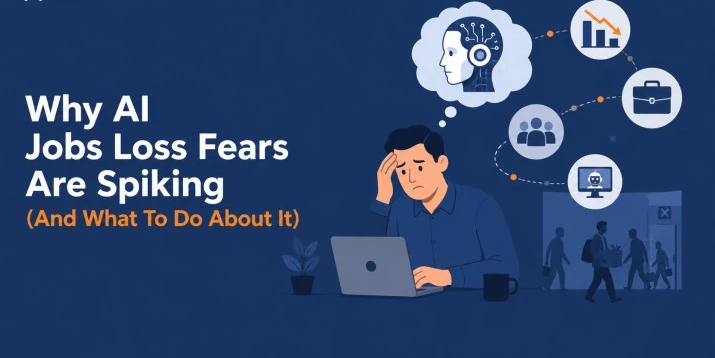
Scroll through LinkedIn or talk to tech professionals in Bengaluru, Hyderabad, or Pune, and a single anxiety dominates the conversation: Artificial Intelligence is taking tech jobs. Headlines detailing corporate restructuring in major IT hubs have left mid-level developers and software testers questioning their career longevity.
However, a closer examination of market data reveals a striking paradox. While surveys suggest that over 66% of Indian AI and IT workers harbor deep fears of job displacement due to automation, macroeconomic findings tell a very different story. Recent research by Nomura indicates that AI-linked job creation in India has actually outpaced AI-related job cuts by more than 51,000 positions.
This sharp contrast raises critical questions for every Indian IT professional: Are layoff fears overstated, or is the nature of employment undergoing a permanent, irreversible transformation?
The Great Indian IT Paradox: Fear vs. Reality
The anxiety among Indian software professionals is not entirely unfounded. For decades, India’s massive IT export engine was built on linear volume growth—hiring thousands of fresh engineering graduates each year to manage maintenance, manual testing, and routine coding tasks.
Generative AI models, automated code assistants like GitHub Copilot, and intelligent testing frameworks have directly targeted these repetitive tasks. As tier-1 IT firms slow down mass campus recruitment, panic sets in among early-to-mid-career engineers.
Yet, the data from Nomura highlights a structural shift rather than an industry death spiral. Major enterprise clients in North America and Europe are not cutting their tech budgets; they are reallocating funds toward digital transformation, cloud architecture, and proprietary AI integration. Consequently, hiring in specialized technical domains is growing faster than legacy positions are being eliminated.
Which Roles Are Shrinking in Indian IT Hubs?
To understand where the market is heading, professionals must distinguish between structural redundancy and overall job reduction. The positions facing the sharpest declines across Indian tech corridors include:
- Manual Quality Assurance (QA) and Testing: Scripting basic test cases and manual execution are now largely automated by AI-driven testing tools.
- L1 Support and Helpdesk Services: Routine IT support tickets are increasingly resolved by intelligent agents and conversational bots.
- Basic Code Maintenance and Refactoring: Legacy code migration and boilerplate programming require fewer junior developers than before.
- Entry-Level Data Entry and Processing: Basic database management and manual ETL tasks are being streamlined through automated workflows.
If your daily work consists primarily of predictable, rules-based tasks without deep architectural or strategic input, the vulnerability to automation is genuinely high.
The Hiring Boom: Where Are the 51,000+ New Jobs?
While legacy roles shrink, hiring managers across Global Capability Centres (GCCs) in Bengaluru, Gurugram, and Hyderabad are actively competing for talent in newly emerging fields. The net addition of over 51,000 jobs reported in market analyses is concentrated in key high-demand areas:
1. Data Infrastructure and MLOps
AI systems require robust, clean, and scalable data pipelines. Indian tech firms are aggressively recruiting Data Engineers, MLOps (Machine Learning Operations) specialists, and Cloud Architects proficient in AWS, Azure, and Google Cloud Platform.
2. Applied AI and Integration Engineering
Companies rarely build foundational Large Language Models (LLMs) from scratch. Instead, they require engineers who can connect existing enterprise software with API endpoints, fine-tune open-source models, and secure enterprise data pipelines.
3. AI Security and Governance
As companies deploy generative AI, risks surrounding data leakage, compliance, and algorithmic bias have skyrocketed. Governance leads, cybersecurity analysts, and AI auditors are commanding premium salaries across major Indian metros.
4. Specialized Domain Engineers
Combining deep domain knowledge (such as fintech, healthtech, or supply chain logistics) with software engineering is becoming essential. Tech professionals who understand both business logic and AI implementation remain highly sought after.
Upskilling Infrastructure: Government and Corporate Push
Recognizing this monumental shift, both public institutions and enterprise leaders are making substantial investments to bridge the skill deficit.
Under the Ministry of Electronics and Information Technology (MeitY), initiatives like NASSCOM FutureSkills Prime offer subsidized training modules in AI, Big Data, and Cloud Computing. Furthermore, leading Indian IT service companies are establishing internal training programs to reskill hundreds of thousands of existing employees.
For individual tech workers, investing ₹15,000 to ₹50,000 in recognized industry certifications—such as AWS Certified Machine Learning Specialty or Google Cloud Professional Data Engineer—has shifted from being an optional bonus to an essential career safeguard.
4-Step Action Plan to Future-Proof Your IT Career
If you want to transition from a position vulnerable to automation into a high-growth domain, consider implementing this structured approach:
- Audit Your Daily Workflow: Identify which parts of your current job can be automated using existing AI tools. Focus on building skills in areas that require complex problem-solving and strategic design.
- Master the Basics of Machine Learning & APIs: You do not need a PhD in Mathematics. Focus on practical implementation: Learn Python libraries like PyTorch or TensorFlow, and master REST APIs and vector databases.
- Leverage AI Tools Instead of Resisting Them: Incorporate AI coding assistants into your daily work. Developers who use AI tools effectively deliver higher output and position themselves as modern, high-value tech leaders.
- Strengthen System Architecture and Client Management Skills: AI can generate code snippets, but it cannot gather ambiguous client requirements, design resilient system architecture, or lead cross-functional engineering teams.
Conclusion: Transformation, Not Extinction
The fear gripping 66% of Indian tech workers is rooted in the visible decline of traditional software workflows. However, the reality demonstrated by market data is clear: AI is re-engineering the Indian IT industry, not destroying it.
Job cuts in routine maintenance are being offset by an explosion in high-value, AI-adjacent roles. For Indian IT professionals, the key to long-term career security lies in moving up the value chain—embracing continuous learning, acquiring specialized skills, and leveraging automation to build superior technology solutions.
Frequently Asked Questions
Will AI eliminate fresh graduate hiring in Indian IT companies?
Fresh graduate hiring is not disappearing, but the expectations have shifted. Tier-1 IT companies are reducing mass recruitment for basic coding roles while increasing intake for graduates trained in cloud computing, data engineering, and foundational AI principles.
How long will it take a traditional developer to transition into an AI role?
With consistent effort (10 to 12 hours per week), a software developer with standard programming experience in Java, C++, or Python can learn applied AI engineering, API integrations, and MLOps fundamentals in 6 to 9 months.
Are Global Capability Centres (GCCs) in India hiring more than legacy IT service providers?
Yes. GCCs established by multinational corporations in cities like Bengaluru, Hyderabad, and Pune are currently leading the demand for specialized AI, data, and cloud engineering talent in India.
Support creators
If you found this career analysis helpful, consider supporting our independent tech journalism team on ContentVerse India by sending a tip!
Was this helpful?
Your feedback helps us improve content for everyone.
Liked this piece?
Tip Dhananjay for the work
100% goes to the creator. Send a one-time tip in rupees and back the writing you love.
Dhananjay Chauhan
0 followers · 0 blogs
Creator on ContentVerse. Building, writing, and shipping in public.
0 followers

Discussion