
Decoding India's Growth: Why It's the World's Fastest-Growing Major Economy
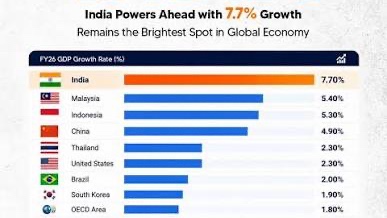
India is now officially recognized by the OECD as the fastest-growing major economy, a testament to its dynamic economic landscape. This article explores the key drivers propelling India's remarkable ascent on the global stage.
Reading this article: 0s
News in 60 words
~150-word AI digest in one read
Thesis, bullets, quote & takeaway — slogan stays "60 words"
2d ·5 min read· 3 · 0 · 0
Full story
The recent OECD report officially confirming India as the world's fastest-growing major economy has sent ripples of optimism across the nation and global financial markets. For every Indian, this isn't just a statistic; it's a profound indicator of shifting fortunes, burgeoning opportunities, and a testament to the resilience and innovation within our diverse landscape. Understanding the multi-faceted engines driving this unprecedented growth is crucial, not only for celebrating our achievements but also for navigating the path ahead.
From the bustling streets of Mumbai to the tech hubs of Bengaluru, a palpable energy underscores India's economic narrative. This growth story is not accidental; it’s a confluence of strategic policy reforms, a vibrant domestic market, and a youthful, aspirational population. Let's delve into the core pillars that are propelling India into a new era of economic prominence.
The Digital Revolution and Public Infrastructure
India's digital public infrastructure (DPI) has been a game-changer, fundamentally transforming how economic activities are conducted. The Unified Payments Interface (UPI), for instance, has revolutionized digital transactions, making them accessible to millions. From street vendors in Delhi accepting payments via PhonePe or Google Pay to large corporations, UPI processes billions of transactions monthly, significantly boosting financial inclusion and formalizing the economy. This seamless digital backbone reduces friction in commerce and fosters a cashless ecosystem.
Beyond digital payments, initiatives like Aadhaar have provided a unique identity to over 1.3 billion Indians, streamlining access to government services and subsidies. The 'Digital India' programme has spurred innovation, improved governance, and created a robust digital economy. Coupled with this, significant investments in physical infrastructure – from new expressways connecting cities like Ahmedabad and Vadodara, to modernizing railway networks and expanding port capacities – are enhancing logistics, reducing costs, and facilitating trade across the country.
A Young Demographic and Robust Domestic Demand
India boasts one of the world's youngest populations, often referred to as its 'demographic dividend.' With a large working-age population and a growing middle class, the country benefits from both a strong labor supply and substantial consumer demand. This demographic advantage translates into a vibrant domestic market, a crucial buffer against global economic volatilities.
Rising disposable incomes, particularly in urban centers and tier-2 cities, fuel consumption across various sectors, from automobiles to consumer electronics and housing. Government schemes aimed at boosting rural incomes and providing affordable housing further stimulate demand. This strong internal consumption acts as a powerful engine, ensuring that economic activity remains robust even when global demand might waver.
Manufacturing Push and Global Supply Chain Integration
The 'Make in India' initiative, coupled with Production Linked Incentive (PLI) schemes, has injected fresh impetus into the manufacturing sector. These schemes offer incentives to both domestic and international companies to boost local production across key sectors like electronics, pharmaceuticals, and automotive components. For example, major smartphone manufacturers are setting up significant assembly lines near Chennai and Noida, creating jobs and fostering a local supply chain.
This strategic focus aims to reduce import dependence, enhance export capabilities, and integrate India more deeply into global supply chains. As global companies look to diversify their manufacturing bases beyond traditional hubs, India is emerging as an attractive destination due to its large market, skilled workforce, and supportive policy environment. The emphasis on becoming a manufacturing hub is not just about producing goods; it’s about creating an entire ecosystem of innovation and employment.
Policy Stability, Reforms, and Investment Climate
Consistent policy reforms and a focus on improving the ease of doing business have significantly bolstered investor confidence. The implementation of the Goods and Services Tax (GST) has streamlined the indirect tax structure, making India a single common market and reducing logistical complexities for businesses operating across states. This has made inter-state trade more efficient and transparent.
Furthermore, reforms in foreign direct investment (FDI) policies, labor laws, and the banking sector have made India a more attractive destination for global capital. The government's commitment to fiscal prudence and macroeconomic stability provides a predictable environment for businesses to plan and invest long-term. This combination of structural reforms and a stable policy outlook is crucial for sustaining the current growth trajectory and attracting further investments.
FAQs About India's Economic Growth
What are the main risks to India's continued growth?
While India's growth trajectory is strong, potential risks include global economic slowdowns impacting exports, inflationary pressures, geopolitical uncertainties, and the challenges of creating sufficient quality jobs for its large young population. Ensuring inclusive growth that benefits all segments of society, particularly in rural areas, remains a key challenge.
How does this growth impact the average Indian citizen?
For the average Indian, this growth translates into improved infrastructure, increased job opportunities in various sectors, better access to digital services, and a wider range of goods and services. It also means a greater sense of national pride and optimism about the future, though the benefits might not be uniformly distributed across all income groups or regions immediately.
What role does technology play in sustaining this growth?
Technology is pivotal. Digital public infrastructure like UPI and Aadhaar reduces transaction costs and increases financial inclusion. AI, machine learning, and automation are improving productivity across industries, while the burgeoning IT services and startup ecosystem continue to drive innovation and create high-value jobs. Technology is not just an enabler but a core driver of efficiency and competitiveness.
Conclusion
India's journey to becoming the world's fastest-growing major economy is a testament to its strategic vision, the dynamism of its people, and the transformative power of digital and physical infrastructure. From the widespread adoption of UPI to the ambitious 'Make in India' drive, the nation is leveraging its unique advantages to forge a path of sustained economic prosperity. While challenges remain, the foundational pillars are robust, positioning India firmly on the global economic map for the foreseeable future. This is a moment of immense potential, urging us all to contribute to and benefit from this exciting growth story.
Support creators
Was this helpful?
Your feedback helps us improve content for everyone.
Liked this piece?
Tip Dhananjay for the work
100% goes to the creator. Send a one-time tip in rupees and back the writing you love.
Dhananjay Chauhan
0 followers · 0 blogs
Creator on ContentVerse. Building, writing, and shipping in public.
0 followers

Discussion