
India's Economic Boom: Why We're the World's Fastest-Growing Economy
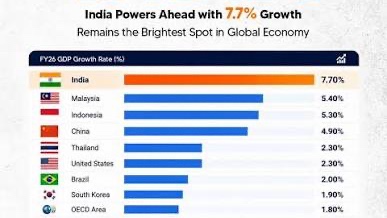
India stands out as the world's fastest-growing major economy, a testament to its robust internal dynamics and strategic reforms. This article explores the multifaceted drivers propelling India's impressive economic ascent, from digital transformation to infrastructure development.
Reading this article: 0s
News in 60 words
~150-word AI digest in one read
Thesis, bullets, quote & takeaway — slogan stays "60 words"
2d ·5 min read· 0 · 0 · 0
Full story
The recent report from the Organisation for Economic Co-operation and Development (OECD) has reaffirmed what many in India already feel: our nation is unequivocally the fastest-growing major economy globally. This isn't just a statistic; it's a profound shift impacting every facet of life, from job creation in tier-2 cities to the accessibility of services in rural areas. Understanding the engines behind this remarkable growth is crucial for every Indian citizen, investor, and business owner looking to navigate and capitalize on this exciting era.
This robust performance isn't a fluke but the culmination of strategic policy decisions, technological adoption, and a unique demographic advantage. As we continue to build a 'New India', the underlying drivers of this boom deserve a closer look, offering insights into the present and a glimpse into the future trajectory of our economy.
Digital Transformation and Financial Inclusion
One of the most significant accelerators of India's economic growth has been its unparalleled digital public infrastructure. The UPI (Unified Payments Interface) system, for instance, has revolutionized transactions, making digital payments ubiquitous from a roadside vendor in Chennai to a bustling mall in Delhi. In October 2023 alone, UPI processed over 11 billion transactions worth ₹17.16 lakh crore, demonstrating its immense scale and efficiency.
Coupled with Aadhaar, which provides a unique digital identity, and the Jan Dhan Yojana, which has brought over 50 crore unbanked individuals into the formal banking system, India has created a powerful ecosystem for financial inclusion. This has not only boosted consumption by making credit and services more accessible but also streamlined government welfare schemes, reducing leakages and ensuring direct benefit transfers to beneficiaries across states like Uttar Pradesh and Maharashtra.
Infrastructure Push and Manufacturing Revival
The government's unwavering focus on infrastructure development is visibly transforming the nation's landscape. Massive investments in roads, railways, ports, and airports are dramatically improving connectivity and logistics. Projects like the Delhi-Mumbai Expressway, which will reduce travel time significantly, and the expansion of metro networks in cities like Pune and Ahmedabad are enhancing productivity and creating numerous employment opportunities.
Simultaneously, initiatives like 'Make in India' and the Production Linked Incentive (PLI) schemes are revitalizing the manufacturing sector. These schemes offer incentives to both domestic and international companies to set up and expand manufacturing units in India, particularly in electronics, automobiles, and pharmaceuticals. States like Tamil Nadu and Gujarat are witnessing a surge in factory setups, attracting significant foreign direct investment (FDI) and positioning India as a global manufacturing hub, reducing reliance on imports and boosting exports.
Demographic Dividend and Growing Middle Class
India's young and growing population is often touted as its greatest asset, and rightly so. With a median age significantly lower than many developed economies, India possesses a vast pool of working-age individuals. This 'demographic dividend' translates into a larger workforce, higher savings rates, and increased consumption.
The rapid expansion of India's middle class is a critical driver of domestic demand. As incomes rise, so does the aspiration for better housing, education, healthcare, and consumer goods. This burgeoning demand creates a powerful internal market, sustaining growth even amidst global economic uncertainties. From buying new homes in Hyderabad to investing in education for their children, the Indian middle class is a robust pillar of the economy.
Policy Reforms and Business Environment
Over the past decade, India has undertaken significant policy reforms aimed at improving the ease of doing business. The implementation of the Goods and Services Tax (GST) streamlined the indirect tax structure, creating a single national market. Corporate tax rates have been rationalized, making India a more attractive destination for investment.
Further efforts to simplify regulations, digitize government services, and promote startups through initiatives like 'Startup India' have fostered a more dynamic and investor-friendly environment. These reforms have boosted investor confidence, leading to increased foreign direct investment (FDI) inflows across various sectors, from renewable energy to technology startups in Bengaluru.
FAQs About India's Economic Growth
What are the main challenges to sustaining this growth?
While India's growth trajectory is impressive, challenges remain. These include managing inflation, particularly food and energy prices, addressing income inequality, and ensuring job creation keeps pace with the growing workforce. Geopolitical uncertainties and global economic slowdowns also pose external risks that India must navigate carefully.
How does this growth impact the average Indian citizen?
For the average Indian, this growth translates into improved infrastructure, better access to digital services, and increased employment opportunities, particularly in manufacturing and the services sector. It also means a greater availability of goods and services, and potentially higher disposable incomes, though the benefits can vary across different income groups and regions.
Is this growth inclusive across all states and income groups?
While the economic boom is widespread, disparities persist. States with stronger industrial bases and better infrastructure often experience faster growth. The government is actively implementing schemes like the Aspirational Districts Programme and various social welfare initiatives to ensure that the benefits of growth reach marginalized communities and backward regions, promoting more inclusive development.
Conclusion
India's journey to becoming the world's fastest-growing major economy is a testament to its resilience, strategic vision, and the dynamism of its people. The synergistic effect of digital transformation, massive infrastructure investments, a favorable demographic profile, and continuous policy reforms has created a powerful momentum. As India continues to leverage these strengths, it is not just growing rapidly but also building a sustainable foundation for future prosperity, promising a brighter economic future for all its citizens.
This is educational content, not financial advice.
Support creators
Was this helpful?
Your feedback helps us improve content for everyone.
Liked this piece?
Tip Dhananjay for the work
100% goes to the creator. Send a one-time tip in rupees and back the writing you love.
Dhananjay Chauhan
0 followers · 0 blogs
Creator on ContentVerse. Building, writing, and shipping in public.
0 followers

Discussion