
Rust vs Go in 2026: Which Language Should Indian Backend Developers Learn?
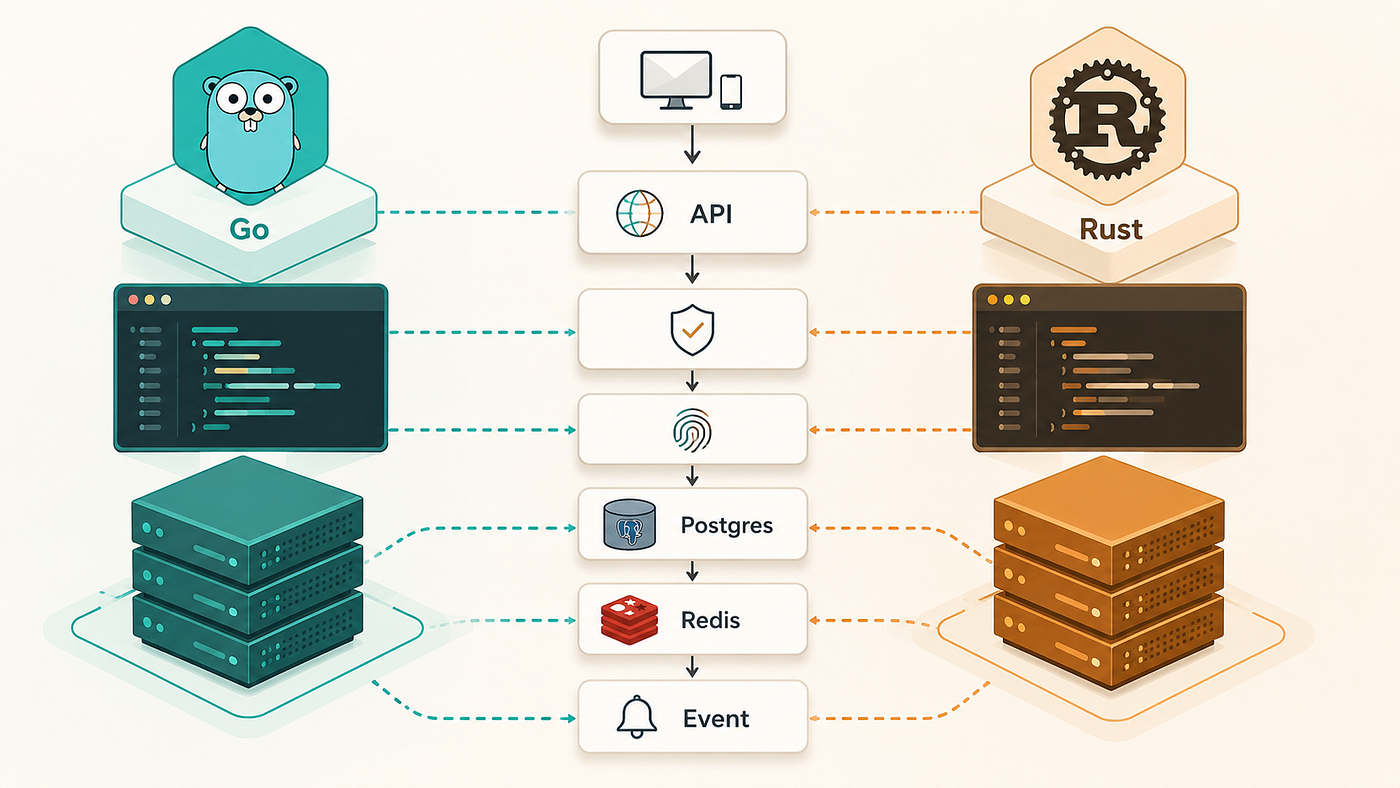
As Indian tech hubs expand Global Capability Centres (GCCs), engineering priorities are shifting towards systems that slash cloud infrastructure costs. Choosing between Rust and Go in 2026 depends on whether you value rapid deployment velocity or ultra-high system performance.
Reading this article: 0s
News in 60 words
~150-word AI digest in one read
Thesis, bullets, quote & takeaway — slogan stays "60 words"
1h ·6 min read· 0 · 0 · 0
Full story
Indian software engineering is experiencing a structural pivot. Over the past three years, cities like Bengaluru, Hyderabad, Pune, and Gurugram have seen a massive surge in Global Capability Centres (GCCs) established by Fortune 500 enterprises. Alongside this enterprise growth, Indian tech unicorns are re-architecting their backend services to curb ballooning cloud bills on Amazon Web Services (AWS) and Google Cloud Platform (GCP).
For years, Java, Node.js, and Python dominated backend engineering across India's IT landscape. However, as scale increases and cloud compute costs become a critical metric for profitability, engineering teams are turning to compiled, statically typed modern languages: Rust and Go (Golang). Both languages offer distinct philosophies, performance guarantees, and career trajectories. If you are an Indian software engineer planning your career stack for 2026 and beyond, deciding between Rust and Go is one of the most important technical choices you will make.
The GCC Push: Why Indian Enterprises Are Rethinking Cloud Costs
To understand why Rust and Go are trending, you have to look at the financial pressures facing tech leads in Indian engineering centers. Running massive Kubernetes clusters serving millions of concurrent requests on legacy runtime environments incurs huge monthly compute bills. Interpreted languages and garbage-collected runtimes with large memory footprints require heavier cloud virtual machines.
GCCs operating out of Hyderabad and Bengaluru are tasked with building infrastructure platforms that run globally at scale. Rewriting high-throughput microservices from Java or Node.js to Go or Rust routinely cuts memory consumption by 60% to 80% and slashes CPU utilization. In an era where Indian startups and enterprise hubs are audited strictly on unit economics, choosing a runtime that cuts cloud spend translates directly into operational efficiency.
Go in 2026: The Pragmatic Workhorse of Cloud-Native Infrastructure
Created at Google, Go was explicitly designed for massive codebases worked on by thousands of engineers. Its philosophy centers on extreme simplicity, fast compilation, and built-in concurrency through goroutines.
Why Go Dominates Indian Microservices
Go has established itself as the de facto language of cloud-native computing. Modern DevOps toolchains—including Kubernetes, Docker, Terraform, and Prometheus—are written in Go. For Indian backend developers working on distributed microservices, Go offers a gentle learning curve.
- Rapid Onboarding: A developer proficient in Java or Python can pick up Go fundamentals within two weeks and write production-grade code in a month.
- Built-in Concurrency: Go handles thousands of concurrent HTTP connections smoothly using lightweight goroutines without manual thread management.
- Hiring Availability: Because Go is straightforward to teach, engineering managers in Indian tech hubs can quickly upskill existing teams without long recruitment cycles.
Job Market and Salaries for Go in India
Go developer demand in India is high and stable. From fintech platforms handling millions of daily Unified Payments Interface (UPI) transactions to cloud security platforms in Pune, Go is a staple. Mid-to-senior Go developers in Bengaluru and Hyderabad typically command annual compensation packages ranging between ₹18 Lakhs and ₹45 Lakhs, depending on system design experience and product scale.
Rust in 2026: Uncompromising Memory Safety and Peak Performance
Rust, backed by the Rust Foundation and adopted widely by tech giants, takes a radically different approach. It delivers the bare-metal performance of C and C++ while providing complete memory safety at compile time without a garbage collector.
Why Rust Is Surging in Next-Gen Indian Tech
Rust uses a strict model of ownership and borrowing enforced by its compiler. This eliminates common bugs like null pointer dereferences, data races, and buffer overflows before code ever reaches production.
- Zero-Cost Abstractions: Rust offers high-level syntax without runtime performance overhead.
- Predictable Latency: Without a garbage collector periodically pausing execution, Rust provides deterministic execution speeds ideal for real-time systems.
- Resource Efficiency: Rust programs can run on incredibly tiny footprints, making them ideal for high-frequency trading platforms, database engines, edge computing, and WebAssembly applications.
Job Market and Salaries for Rust in India
While the total volume of Rust job openings in India is currently smaller than Go, the roles are highly specialized and carry premium compensation. Specialized GCCs, cybersecurity firms, database startups, and crypto/fintech infrastructure teams in India actively recruit Rust talent. Senior Rust engineers with deep systems experience often command packages ranging from ₹25 Lakhs to ₹60+ Lakhs LPA.
Head-to-Head Comparison: Velocity vs Control
When evaluating both languages for your engineering career, consider how they stack up across key developer metrics:
- Learning Curve: Go is deliberately minimalist with only 25 keywords. Rust has a steep learning curve requiring developers to fight the "borrow checker" until memory ownership concepts click.
- Development Velocity: Go wins for fast feature delivery, building REST APIs, and standing up web services quickly. Rust shines when safety, ultra-low latency, and thread safety are paramount.
- Ecosystem Maturity: Go has an incredible library ecosystem for web frameworks, database drivers, and microservices. Rust's ecosystem is growing rapidly (with crates like Tokio and Axum), but requires more hands-on system architecture.
Which Language Should You Learn First in 2026?
Your choice should align with your target roles and technical interests within the Indian market:
- Choose Go if: You want to specialize in cloud-native backend development, microservices, DevOps engineering, or API platforms. If your goal is to land high-paying roles quickly in product startups, payment aggregators, or enterprise cloud teams, Go offers the highest return on investment.
- Choose Rust if: You are passionate about systems programming, browser engines, embedded devices, database internals, low-latency fintech infrastructure, or cryptography. Rust is ideal if you are willing to invest time mastering complex memory mechanics for specialized, high-tier technical roles.
A pragmatic approach for many Indian engineers is to learn Go first to secure robust backend roles, while gradually learning Rust on personal projects to build deep systems engineering capability.
Frequently Asked Questions
Is Rust replacing Go in Indian tech startups?
No, Rust is not replacing Go; they serve different operational niches. Go is used for rapid backend application development, while Rust replaces C and C++ in areas requiring maximum performance, safety, and strict resource management.
How long does it take an experienced Java developer in India to learn Go versus Rust?
An experienced Java or C# developer can become productive in Go within 2 to 3 weeks. Mastering Rust, including its memory ownership model and borrow checker, typically requires 2 to 3 months of deliberate practice.
Which language pays higher salaries in Indian tech hubs?
On average, Rust roles report higher salary ceilings due to the scarcity of skilled systems developers and the complex nature of the domain. However, Go offers significantly more total job vacancies across Indian tech centers.
Conclusion
Both Rust and Go are long-term winners in the modern software landscape. As Indian GCCs and tech startups continue prioritizing cloud resource optimization and system reliability, proficiency in either language will position you well above standard backend development talent pools. Focus on building real-world projects, understanding distributed systems architecture, and mastering low-cost runtime practices.
Support creators
If you found this technical guide helpful, consider tipping the author on ContentVerse India to support in-depth software engineering journalism.
Was this helpful?
Your feedback helps us improve content for everyone.
Liked this piece?
Tip Dhananjay for the work
100% goes to the creator. Send a one-time tip in rupees and back the writing you love.
Dhananjay Singh
0 followers · 0 blogs
Creator on ContentVerse. Building, writing, and shipping in public.
0 followers


Discussion