
How India Is Fighting Superbugs: New Antibiotic Breakthroughs Explained
India faces a growing threat from antimicrobial resistance, but domestic scientists are striking back with groundbreaking novel drug discoveries. Learn how Indian research institutes and government policies are reshaping the global battle against drug-resistant superbugs.
Reading this article: 0s
News in 60 words
~150-word AI digest in one read
Thesis, bullets, quote & takeaway — slogan stays "60 words"
1h ·6 min read· 0 · 0 · 0
Full story
In intensive care units across Mumbai, Delhi, and Bengaluru, doctors are increasingly encountering a terrifying scenario: common bacterial infections that refuse to yield to even the strongest available antibiotics. These drug-resistant pathogens, popularly known as superbugs, represent one of the most critical public health threats of the 21st century. Antimicrobial Resistance (AMR) occurs when bacteria, viruses, fungi, and parasites evolve over time and no longer respond to medicines, making infections harder to treat and increasing the risk of disease spread, severe illness, and death.
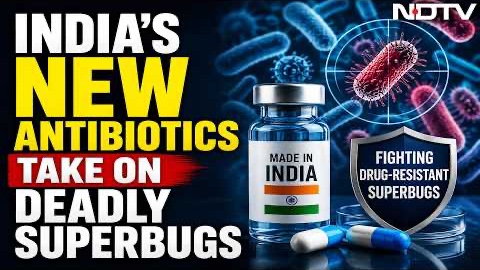
While the situation is urgent, Indian science is stepping up to the challenge. Recent reporting by major outlets like NDTV highlighted significant breakthroughs by researchers at top Indian institutes who have identified novel molecules capable of neutralizing resistant bacterial strains. This article explores the root causes of India's superbug crisis, the groundbreaking domestic scientific advances aimed at solving it, and practical steps every citizen must take to protect our fragile antibiotic umbrella.
The Scale of the AMR Crisis in India
India has historically been one of the largest consumers of antibiotics globally. Several factors have accelerated the emergence of superbugs across urban and rural healthcare settings:
- Over-the-Counter Sales: Despite strict regulatory guidelines, antibiotics are frequently dispensed without a valid medical prescription at local chemists.
- Self-Medication: Many patients take left-over antibiotics or use them to treat viral illnesses like the common cold, flu, or seasonal dengue, against which antibiotics are completely ineffective.
- Agricultural and Poultry Use: Antibiotics are often added to animal feed to promote growth or prevent disease in crowded farming environments, allowing resistant strains to enter the food supply chain.
- Environmental Contamination: Effluent runoff from pharmaceutical manufacturing hubs, such as those near Hyderabad and Baddi, has historically released active pharmaceutical ingredients into local water bodies, creating breeding grounds for superbugs.
Infections caused by pathogens like Klebsiella pneumoniae, Acinetobacter baumannii, and Pseudomonas aeruginosa have shown rising resistance to carbapenems—a class of highly effective antibiotics usually reserved for severe hospital-acquired infections.
Breakthrough Discoveries by Indian Researchers
To counter this rising threat, Indian scientific organizations are shifting focus from simply synthesizing generic versions of existing drugs to discovering novel chemical entities and antibacterial mechanisms.
CSIR and IIT Lab Innovations
Researchers at premier institutes under the Council of Scientific and Industrial Research (CSIR), alongside various Indian Institutes of Technology (IITs), have recently isolated novel antimicrobial peptides and small molecules. For instance, teams at CSIR-Central Drug Research Institute (CDRI) in Lucknow and CSIR-Institute of Microbial Technology (IMTECH) in Chandigarh have been synthesizing molecules that target the cell walls of drug-resistant bacteria in entirely new ways.
IISc Breakthroughs in Membrane Disruption
Scientists at the Indian Institute of Science (IISc) in Bengaluru have focused on engineered nano-materials and synthetic peptides that physical break through the protective outer membrane of superbugs. Unlike traditional antibiotics, which targeted specific metabolic pathways that bacteria could mutate to bypass, physical disruption makes it significantly harder for the bacteria to develop resistance.
Phytomedicine and Traditional Knowledge Synergy
Indian researchers are also combining advanced biotechnology with traditional ethnobotanical knowledge. By isolating active bio-compounds from indigenous medicinal plants, researchers are creating synergistic drug formulations. When combined with existing low-potency antibiotics, these plant extracts act as resistance-breakers, restoring the antibiotic's ability to kill resistant strains.
Government Policies and Surveillance Initiatives
Scientific innovation alone cannot solve the problem without robust regulatory enforcement and policy frameworks.
- National Action Plan on AMR (NAP-AMR): Aligned with the World Health Organization's global framework, India launched its National Action Plan to enhance surveillance, improve infection control in hospitals, and promote rational drug use.
- The Red Line Campaign: To prevent misuse, the Ministry of Health and Family Welfare introduced a distinctive vertical red line on prescription medicine packaging, signaling to consumers that the drug must only be consumed under medical supervision.
- ICMR Surveillance Network: The Indian Council of Medical Research (ICMR) established the Antimicrobial Resistance Surveillance Network (AMRSN) across leading tertiary care hospitals to track trends in bacterial resistance nationwide and publish annual guidance reports for clinicians.
- Schedule H1 Regulations: The Central Drugs Standard Control Organization (CDSCO) placed critical broad-spectrum antibiotics under Schedule H1, requiring chemists to maintain separate registers containing doctor details, patient names, and dispensed quantities for three years.
What Patients and Doctors Must Do Right Now
Preventing a post-antibiotic era where routine surgeries or minor injuries become life-threatening requires collective behavioral change across Indian society.
Guidance for Consumers and Patients
- Never Self-Medicate: Never purchase antibiotics without a fresh, valid prescription from a registered medical practitioner.
- Complete the Prescription: Always finish the complete course prescribed by your doctor, even if you feel completely recovered after two days. Stopping early leaves behind the strongest bacteria, allowing them to mutate into superbugs.
- Refuse Antibiotics for Viral Infections: Do not demand antibiotic pills from your doctor when diagnosed with a common cold, viral fever, or cough. Ask whether diagnostic tests like blood cultures or CRP tests are appropriate before starting treatment.
- Proper Disposal: Do not flush expired or unused medicines down the drain or throw them into open garbage heaps, as this contaminates soil and groundwater.
Guidance for Healthcare Providers
Doctors are encouraged to follow diagnostic stewardship—relying on microbiological culture and sensitivity reports rather than immediately prescribing empirical broad-spectrum antibiotics. Hospital infection control committees must also enforce strict hand hygiene and sterilization standards to stop hospital-acquired superbug transmission.
The Financial Burden of AMR in India
Treating a standard bacterial infection with generic first-line antibiotics might cost a patient between ₹100 and ₹500. However, when an infection becomes drug-resistant, the treatment cost skyrockets dramatically. Patients often require prolonged ICU admissions, specialized diagnostics, and expensive, imported last-resort reserve antibiotics like colistin or novel combination therapies, raising total medical bills to lakhs of rupees. This economic strain frequently pushes middle- and low-income Indian families into medical debt.
Frequently Asked Questions (FAQs)
What is the primary difference between a normal bacterium and a superbug?
A standard bacterium can be easily eliminated by conventional antibiotics. A superbug is a bacterial strain that has mutated or acquired resistance genes, making it immune to multiple standard antibiotic treatments.
Why are antibiotics useless against the common cold and flu?
The common cold, flu, and viral fevers are caused by viruses, not bacteria. Antibiotics work exclusively by destroying bacterial structures or inhibiting bacterial reproduction; they have zero biological effect on viruses.
What does the red line on medicine strips mean in India?
The red line on a medicine strip indicates that the drug belongs to controlled schedules (such as Schedule H or H1) and must only be sold by retail chemists upon presenting a valid prescription from a registered medical doctor.
Conclusion
The discovery of novel antibiotic compounds by Indian scientists offers genuine hope in the battle against drug-resistant superbugs. However, laboratory scientific victories must be matched by responsible prescribing, strict drug retail compliance, and widespread public awareness. Protecting our existing and future medicines requires every individual in India to treat antibiotics as a precious, non-renewable resource.
Support creators
If you found this scientific breakdown helpful, consider tipping the independent researchers and writers on ContentVerse India to help us produce more deeply researched health stories.
Was this helpful?
Your feedback helps us improve content for everyone.
Liked this piece?
Tip Dhananjay for the work
100% goes to the creator. Send a one-time tip in rupees and back the writing you love.
Dhananjay Chauhan
0 followers · 0 blogs
Creator on ContentVerse. Building, writing, and shipping in public.
0 followers

Discussion