
India's PG Medical Seat Expansion: What 5,000 New Seats Mean for Aspiring Doctors
The Cabinet has approved a plan to add 5,000 postgraduate medical seats across India by 2028-29. This expansion aims to ease intense NEET PG competition and strengthen specialist care in Tier-2 and Tier-3 cities.
Reading this article: 0s
News in 60 words
~150-word AI digest in one read
Thesis, bullets, quote & takeaway — slogan stays "60 words"
1h ·5 min read· 0 · 0 · 0
Full story
A Major Shift in India's Post-Graduate Medical Education
For tens of thousands of MBBS graduates in India, cracking the National Eligibility cum Entrance Test for Post-Graduation (NEET PG) is one of the toughest career milestones. Every year, over 2 lakh candidates compete for a limited number of clinical seats, leading to intense competition and multi-year drop gaps.
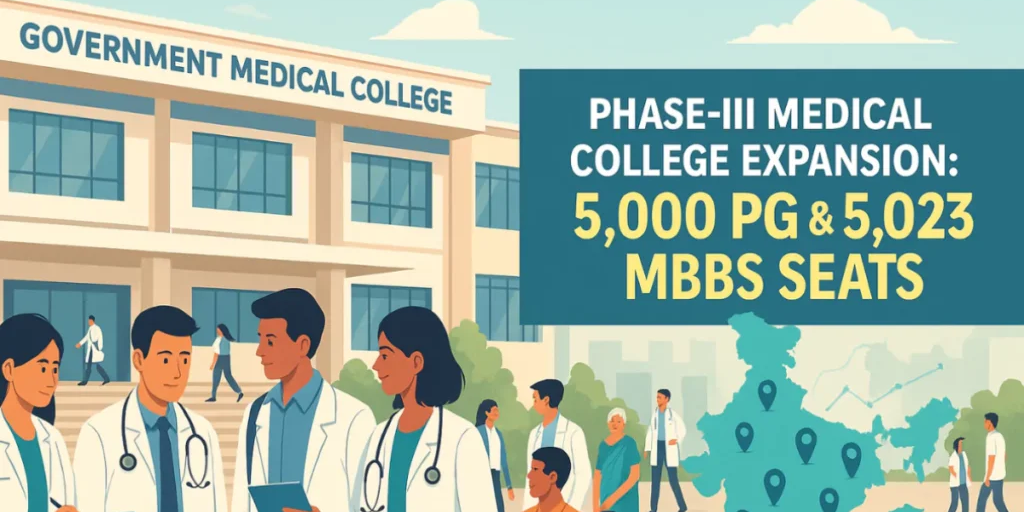
To address this critical gap, the Union Cabinet recently approved a comprehensive scheme to add 5,000 additional postgraduate medical seats across government and private institutions by the 2028–29 academic session. Expanding on India's existing pool of roughly 86,360 PG seats (including MD, MS, and diploma courses), this move promises to reshape the landscape of medical specialization in the country.
This decision comes at a time when district hospitals and government medical colleges in cities like Bhopal, Ranchi, and Kozhikode face acute shortages of specialist physicians, surgeons, and anesthesiologists. Here is an in-depth look at what this seat expansion entails, how it will be implemented, and what it means for young medical aspirants.
The MBBS to PG Imbalance: Why Expansion Was Urgent
Over the past decade, the Indian government significantly increased undergraduate (MBBS) seats, pushing the total capacity past 1,00,000 across government and private colleges. However, postgraduate capacity failed to keep pace at the same rate, creating a massive bottleneck at the specialty entry level.
Key Bottlenecks in the Current System:
- High Candidate-to-Seat Ratio: Nearly 2.2 lakh candidates appeared for NEET PG recently, competing for less than 45,000 clinical MD/MS seats in core specialties.
- Geographic Disparity: Specialist care remains concentrated in tier-1 metropolitan hubs like Mumbai, Delhi, and Bengaluru, leaving rural district healthcare centers severely understaffed.
- Reliance on Foreign Degrees: Thousands of doctors previously sought foreign post-graduation or fellowship programs due to limited seat availability domestically.
By increasing PG seat density, the National Medical Commission (NMC) aims to create a sustainable pipeline of specialized doctors directly serving secondary and tertiary hospitals.
Implementation Roadmap: How 5,000 Seats Will Be Added by 2028–29
The addition of 5,000 PG seats will not happen overnight. The Central scheme utilizes a structured phase-wise funding model co-shared between the Centre and State governments (60:40 for general states, 90:10 for North-Eastern and Himalayan states).
Major Mechanisms for Seat Creation:
- Upgrading District Hospitals: Non-teaching district hospitals with 200+ beds are being transformed into teaching institutions offering Diplomate of National Board (DNB) and post-graduate medical seats.
- Expanding Infrastructure in Existing Colleges: Central assistance funding up to ₹1.2 crore per seat is allocated for upgrading modular operation theaters, intensive care units (ICUs), diagnostic laboratories, and hostel facilities.
- Relaxing NMC Faculty Norms: The NMC has rationalized teacher-student ratios for PG courses, allowing senior professors to guide additional post-graduate residents without compromising training quality.
Priority Specialties: Where Will the New Seats Be Created?
Not all medical departments suffer from the same shortage. The Ministry of Health and Family Welfare has identified critical specialty areas where seat addition will be prioritized based on national disease burdens and clinical emergency requirements.
- Critical Care & Anesthesiology: Vital for expanding surgical capacity and managing high-dependency care units.
- General Medicine & Pediatrics: Essential for managing chronic lifestyle diseases, maternal health, and child healthcare in rural communities.
- Obstetrics & Gynecology: Directly tied to reducing maternal mortality rates across high-priority districts under government health missions.
- Radiology & Pathology: Core diagnostic branches necessary to support new AIIMS campuses and upgraded district civil hospitals.
Challenges: Infrastructure, Stipends, and Faculty Quality
While adding seats on paper is a welcome move, the medical community emphasizes that quality must accompany quantity. Increasing seat counts presents operational challenges that state health authorities must navigate.
1. Faculty Shortages
Several newly established state medical colleges struggle with faculty deficits. Providing adequate clinical exposure requires experienced senior consultants who can supervise complex surgeries and patient management.
2. Stipend Disparities
Post-graduate medical residents form the backbone of hospital clinical service. However, stipend amounts vary dramatically across Indian states. While PG residents in New Delhi receive over ₹90,000 per month, residents in certain state government colleges receive under ₹45,000 per month, often with delayed disbursements. Ensuring uniform, timely stipends remains a critical demand among resident doctor associations.
3. Bed-to-Patient Ratios
To maintain high academic standards, every PG resident must handle an adequate clinical caseload. Ensuring that upgraded hospitals attract sufficient patient inflow is crucial for surgical and procedural learning.
Strategic Takeaways for NEET PG Aspirants
For current MBBS interns and junior doctors preparing for NEET PG, this seat expansion offers clear strategic advantages:
- Lower Cutoff Ranks for Clinical Branches: As seat capacity widens, the closing ranks for sought-after branches like General Surgery, Pediatrics, and Orthopedics are expected to shift favorably.
- Broader Options via DNB Programs: Aspirants should actively consider DNB courses in upgraded broad-specialty district hospitals, which now offer equivalent academic recognition to university MD/MS degrees.
- State Quota Advantages: Since many seats will be added in state-run colleges, candidates utilizing state domicile quotas stand to gain significant rank leverage during counseling rounds.
Looking Ahead: Strengthening India's Health Infrastructure
The planned addition of 5,000 PG medical seats by 2028–29 represents a pragmatic step toward balancing India's doctor-to-population ratio. By converting district medical infrastructure into vibrant centers of learning, the initiative not only provides brighter career pathways for medical graduates but also ensures that specialized healthcare reaches affordable public facilities across every corner of the country.
Frequently Asked Questions (FAQs)
Q1: When will these 5,000 new PG medical seats become available for NEET PG candidates?
The rollout is phased over five years up to the 2028–29 academic session. Partial seat additions will reflect in the seat matrix during annual counseling rounds conducted by the Medical Counselling Committee (MCC) and state authorities.
Q2: Are these new PG seats restricted only to government medical colleges?
While a major portion of central funding goes toward government colleges and district hospitals, private medical institutions and trust hospitals that meet revised NMC infrastructure and faculty standards can also apply for seat expansion.
Q3: Is a DNB degree equivalent to an MD/MS degree in India?
Yes, the National Medical Commission and the Ministry of Health officially treat DNB qualifications awarded by the National Board of Examinations in Medical Sciences (NBEMS) as fully equivalent to MD/MS degrees for clinical practice and teaching positions.
Support creators
If you found this detailed breakdown of India's medical education policies helpful, consider tipping the author on ContentVerse India to support independent journal writing.
Was this helpful?
Your feedback helps us improve content for everyone.
Liked this piece?
Tip Dhananjay for the work
100% goes to the creator. Send a one-time tip in rupees and back the writing you love.
Dhananjay Chauhan
0 followers · 0 blogs
Creator on ContentVerse. Building, writing, and shipping in public.
0 followers


Discussion