
India-AI Impact Summit New Delhi: What It Means for Indian Tech
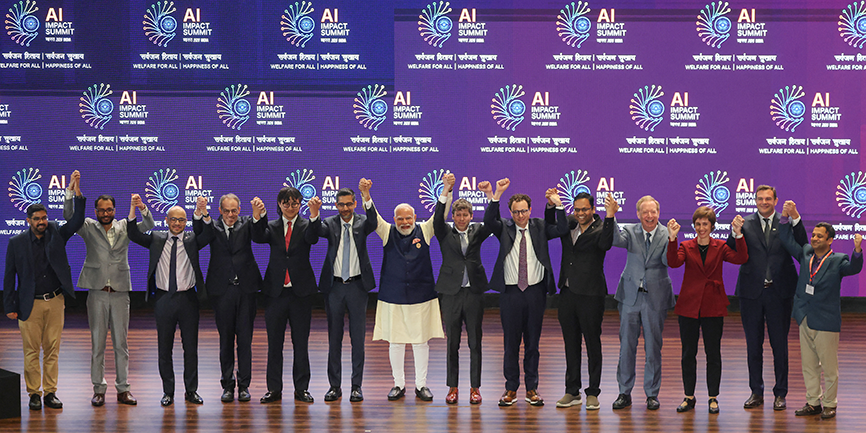
As global technology leaders and policymakers gather in New Delhi for the India-AI Impact Summit, the country stands at a pivotal technological crossroads. This landmark event underscores India's ambition to lead the Global South in sovereign AI infrastructure, multilingual model development, and practical public governance.
Reading this article: 0s
News in 60 words
~150-word AI digest in one read
Thesis, bullets, quote & takeaway — slogan stays "60 words"
2h ·5 min read· 0 · 0 · 0
Full story
Global technology leaders, key cabinet ministers, enterprise CEOs, and pioneering researchers are convening in New Delhi next week for the high-profile India-AI Impact Summit. Hosted amidst a surging global interest in artificial intelligence governance, this landmark event signals India's intent to shift from being merely a talent pool to becoming a primary builder of AI infrastructure.
With the Union Cabinet's recent approval of the ₹10,372 crore IndiaAI Mission, the summit comes at a crucial moment. India is building a national blueprint that balances rapid technological deployment with ethical safety nets. For founders in Bengaluru, engineers in Hyderabad, and policy researchers across the nation, this summit marks a turning point in how artificial intelligence will be funded, regulated, and scaled.
Demystifying the Summit: Core Agenda and Strategic Pillars
The India-AI Impact Summit focuses on practical implementation rather than speculative technology discussions. While global forums in London and San Francisco often focus on existential risk and superintelligence, New Delhi is framing the conversation around public utility, economic growth, and sovereign compute capacity.
The discussions at the summit center around three core tracks:
- Sovereign Infrastructure and Compute Access: Establishing state-backed GPU clusters to reduce reliance on foreign cloud providers.
- Inclusion via Multilingual AI: Harnessing vernacular large language models (LLMs) to serve citizens in native Indian languages.
- Democratized Governance: Developing regulatory frameworks that protect user privacy without stifling homegrown innovation.
By positioning AI as a public good similar to the Unified Payments Interface (UPI) and Aadhaar, India aims to showcase how artificial intelligence can solve systemic challenges in healthcare, agriculture, and education across developing nations.
Boosting the Ecosystem: Compute Facilities and Startup Funding
Access to advanced hardware remains the single largest bottleneck for Indian AI founders. Renting high-end Nvidia H100 GPU clusters on commercial cloud platforms can cost startups tens of thousands of dollars monthly. This creates a high barrier to entry for early-stage companies.
At the summit, delegates will outline the rollout strategy for the national AI compute facility. Under the IndiaAI Mission, the government aims to deploy over 10,000 GPUs through public-private partnerships. This compute capacity will be offered at subsidized rates to Indian startups, academic researchers, and public institutions.
How Indian Startups Benefit
- Lowered Operational Costs: Subsidized GPU access allows local startups like Sarvam AI and Krutrim to train foundational models tailored to Indian contexts without burning through seed capital.
- Public Dataset Availability: The IndiaAI Datasets Platform will offer anonymized non-personal datasets, giving startups high-quality data to train specialized healthcare and agricultural solutions.
- Venture Capital Alignment: Domestic and global venture capital funds are aligning with the summit's initiatives, creating dedicated capital pools for deep-tech and enterprise AI ventures based in India.
Vernacular Intelligence: Bhasini and Multilingual LLMs
India's demographic complexity presents a unique challenge: fewer than 12% of the population speaks English fluently. To ensure AI does not widen the digital divide, the Digital India Bhasini initiative takes center stage at the New Delhi summit.
Bhasini leverages open-source voice datasets and neural machine translation models across 22 scheduled Indian languages. By integrating these models into commercial applications and government portals, technology providers enable citizens to access public services using natural voice commands in Hindi, Tamil, Bengali, Marathi, or local dialects.
For example, rural farmers can inquire about fertilizer subsidies under the PM-Kisan scheme by simply speaking into a smartphone app in their local dialect. The system translates the voice command, processes the data through government databases, and responds verbally in the user's native language.
Regulatory Frameworks: Balancing Safety with Innovation
As AI tools proliferate, discussions around deepfakes, copyright infringement, and algorithmic bias have moved to the top of national security and policy priorities. Policymakers at the summit will discuss actionable standards that align with the Digital Personal Data Protection (DPDP) Act 2023.
Rather than passing heavy-handed legislation that could restrict young startups, Ministry of Electronics and Information Technology (MeitY) officials favor an adaptive governance approach. Key regulatory goals include:
- Mandatory Watermarking: Requiring clear identification labels on AI-generated audio, video, and text content to combat misinformation.
- Algorithmic Accountability: Ensuring financial and healthcare AI platforms undergo audit processes to prevent discriminatory outcomes.
- Data Sovereignty: Mandating that critical personal data used for training AI models remains stored and processed within Indian borders.
This balanced approach aims to reassure international investors while protecting Indian citizens from algorithmic risks.
Actionable Takeaways for Indian Engineers and Founders
For tech professionals monitoring the India-AI Impact Summit, the national priorities offer a clear blueprint for where innovation and investment will flow in the coming years:
- Focus on Application-Layer Solutions: Instead of building generic English LLMs, build industry-specific agents tailored to Indian logistics, local taxation, or localized education.
- Prepare for Compliance: Audit your data pipelines to ensure strict compliance with the DPDP Act 2023, particularly regarding user consent and local data storage.
- Leverage Public Digital Infrastructure: Integrate your platforms with Bhasini APIs and open dataset repositories as they open up through the IndiaAI portal.
Frequently Asked Questions
What is the primary focus of the India-AI Impact Summit in New Delhi?
The summit focuses on establishing sovereign AI infrastructure, expanding GPU compute availability, promoting vernacular language models through Bhasini, and formulating balanced governance policies tailored for India and the Global South.
How will the IndiaAI Mission help early-stage startups?
The ₹10,372 crore IndiaAI Mission provides startups with subsidized access to a national compute grid of over 10,000 GPUs, curated non-personal datasets, and direct government grants for deep-tech research.
Does India plan to introduce a strict AI law like the EU AI Act?
India is adopting an adaptive regulatory model focused on user safety, deepfake identification, and data privacy under the DPDP Act 2023, rather than introducing overly restrictive preemptive laws that could hinder ecosystem growth.
Conclusion
The India-AI Impact Summit in New Delhi represents a clear shift in national strategy. By connecting sovereign compute resources, multilingual dataset projects, and pragmatic governance models, India is establishing itself as an AI implementation powerhouse. For local developers, founders, and enterprises, aligning with these national strategic initiatives offers a sustainable path to scaling tech solutions that address the needs of 1.4 billion citizens.
Support creators
If you found this analysis helpful, consider tipping the author on ContentVerse India to support independent technology journalism.
Was this helpful?
Your feedback helps us improve content for everyone.
Liked this piece?
Tip Dhananjay for the work
100% goes to the creator. Send a one-time tip in rupees and back the writing you love.
Dhananjay Singh
0 followers · 0 blogs
Creator on ContentVerse. Building, writing, and shipping in public.
0 followers

Discussion